Prosperity & Valor Weekly · Weekly paper
October 8–14, 2026
Navy awards production agreements for 30 unmanned vessels
The U.S. Navy’s September 29 awards set a fiscal 2027 target for first deliveries. HII’s work with Louisiana shipyards shows the manufacturing effort behind the naval autonomy program.
Three builders and a delivery target
The U.S. Navy is moving its medium unmanned surface vessel program from an initial round of sea trials into a 30-vessel production purchase. On September 29, 2026, it announced agreements for Galliano Marine Services, HII and Saronic Technologies to supply 10 vessels apiece, citing an average procurement cost of $40 million per vessel. The first deliveries are scheduled before the end of fiscal 2027. [S1]
The timetable applies to the first vessels. The announcement does not specify when all 30 will be delivered or disclose a separate price for each builder’s agreement. [S1]
Louisiana hull construction preceded the awards
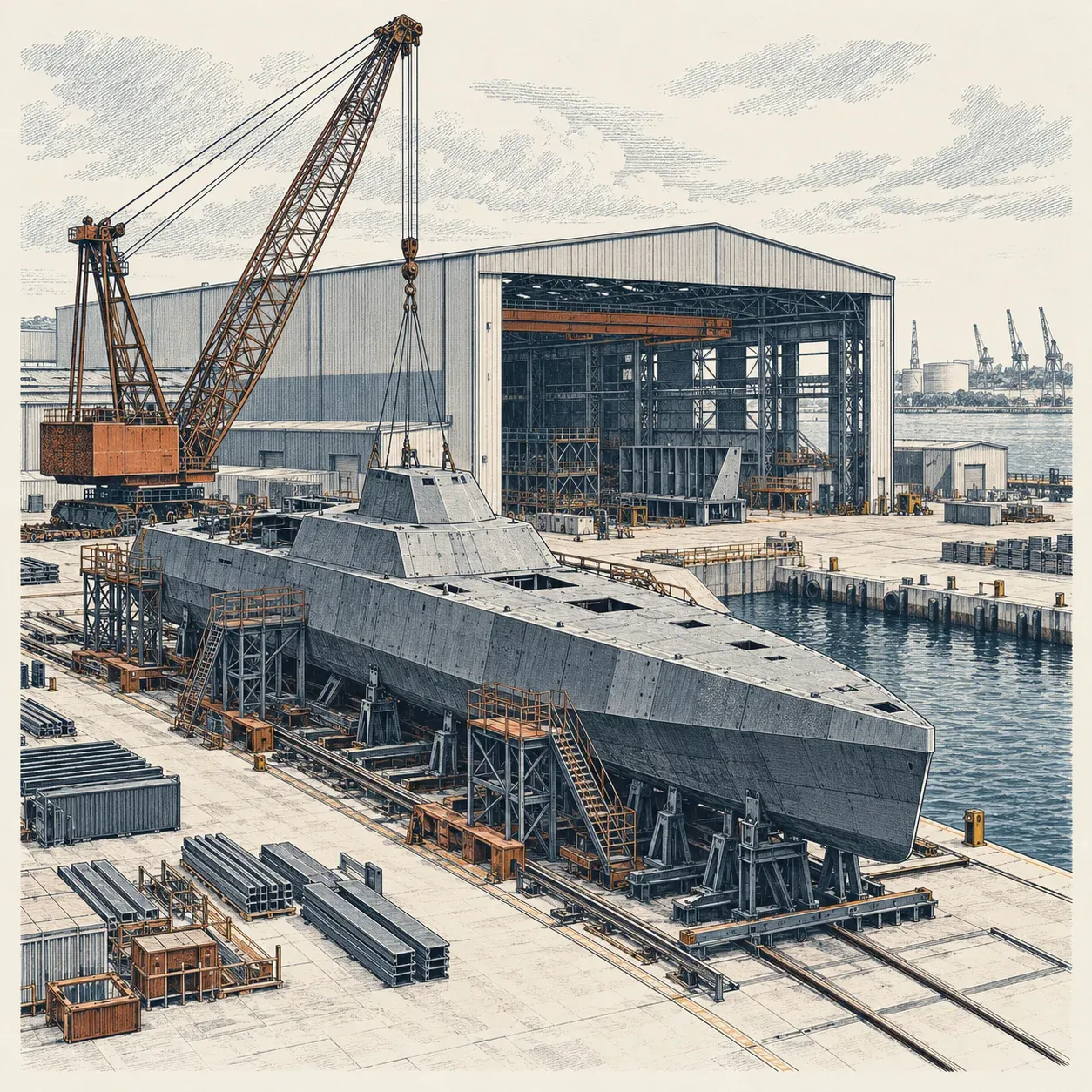
HII had already reported physical progress in Louisiana. In a September 8 update, the company said it and Breaux Brothers Enterprises had completed the structure of the first ROMULUS 151 hull in New Iberia and turned it upright. That step cleared the way to build its deck and pilothouse. At that point, HII said five ROMULUS 151 vessels were under construction: four at Breaux Brothers and one at Halimar Shipyard in Morgan City. Those were construction milestones, with further work still identified in the company’s account. [S3]
Regional shipbuilders support the autonomy program
In its September 29 announcement, HII confirmed that its award covers 10 ROMULUS vessels. The company described a production network involving Breaux Brothers, Halimar and Bayou Metal Supply & Manufacturing in Louisiana. Its approach allows major components and assemblies to be made before final vessel integration, according to HII. The company says it began securing partners, suppliers, capacity and infrastructure for ROMULUS construction in 2025. [S2]
That shipbuilding network supports a separate technology task: integrating autonomy into the vessels. HII describes its Odyssey control architecture as enabling vessels to perceive their surroundings, navigate, manage onboard systems and payloads, and coordinate with other platforms with limited human intervention. These are the company’s descriptions of the system’s functions. [S2]
Sea trials lead to further integration and delivery
The Navy says Phase I examined maritime awareness, autonomous navigation under international collision-prevention rules and long-duration missions. HII separately reported that its autonomy system completed a 420-nautical-mile mission simulation in 28 hours. The company says its Navy-monitored evaluation ran for 13 days; these figures describe that testing, rather than a record of sustained fleet service. [S1] [S2]
The Navy also released a second-phase integration and testing call on September 23 to broaden future offerings. For the 30-vessel purchase, the next delivery checkpoint is the scheduled first handover before fiscal 2027 ends. HII’s five-hull update documents manufacturing activity. The announcements do not establish whether those hulls are among its 10 awarded vessels. [S1] [S2] [S3]
Sources and reporting scope
Reported from the linked primary documents with AI assistance and separate editorial reviews. No interviews, site visits or independent equipment tests were performed. Company statements are attributed; announced plans and research objectives are not completed results.
- S1: U.S. Navy, Direct Reporting Program Manager for Robotic and Autonomous Systems — accessed 2026-10-15
- S3: HII — accessed 2026-10-15
- S2: HII — accessed 2026-10-15
NioCorp secures 15-year Traxys deal for Elk Creek ferroniobium
Traxys will buy half of Elk Creek’s planned ferroniobium output for 15 years. The Nebraska project’s other minerals gain a marketing partner, while financing and delivery conditions remain separate steps.
A customer commitment for Nebraska’s Elk Creek project
NioCorp Developments has secured a binding commitment from Traxys North America to buy half the planned ferroniobium output from its Elk Creek project in southeastern Nebraska. Announced October 13, 2026, the purchase commitment is on a take-or-pay basis for the first 15 years of production. It strengthens the commercial groundwork for a potential U.S. critical-minerals source while leaving financing and delivery conditions to be met. [S2] [S3] [S1]
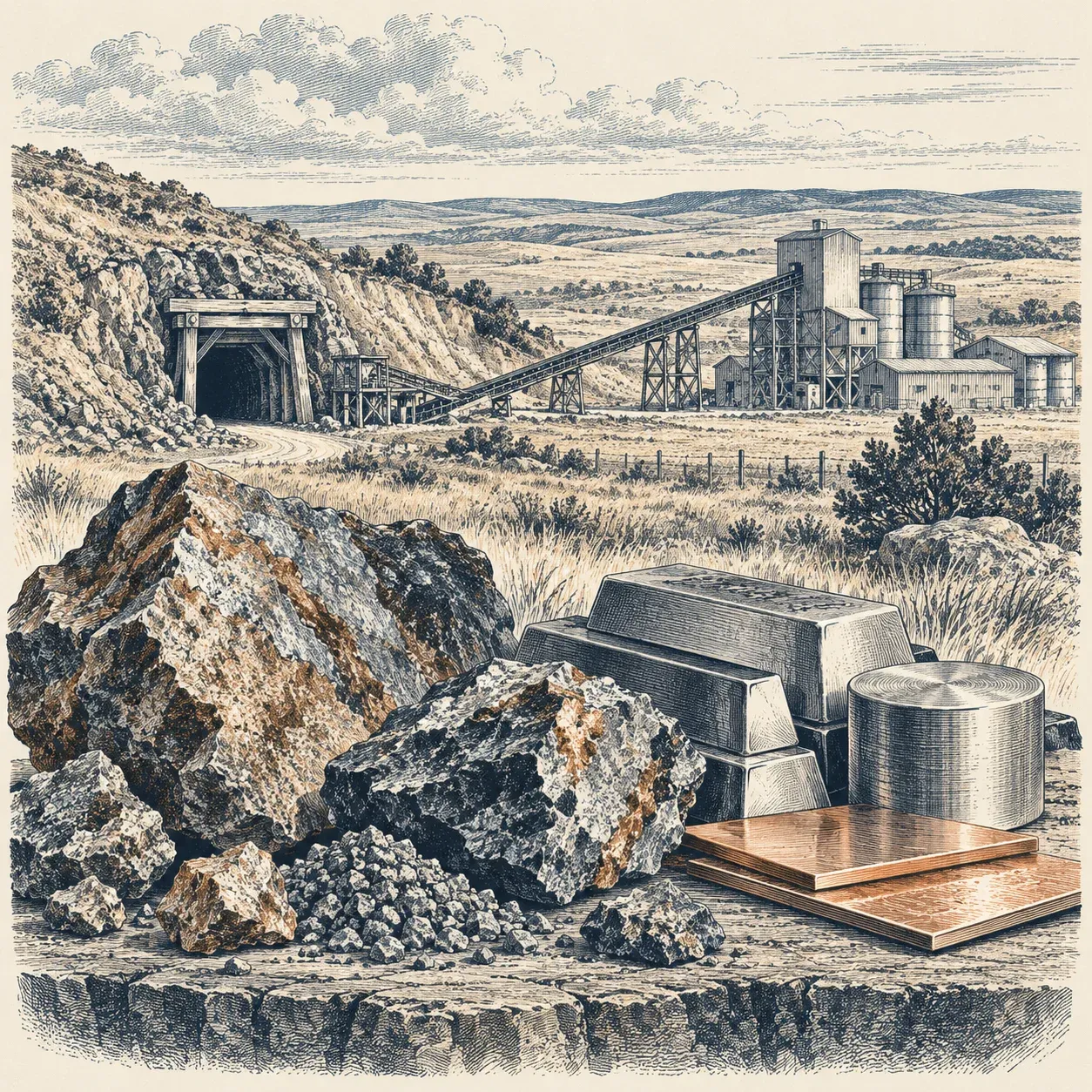
Ferroniobium is an alloy of iron and niobium. NioCorp’s annual filing identifies niobium’s uses in steel for vehicles, bridges, buildings and pipelines, putting the material at work across transportation and construction. [S3]
Purchase commitments and marketing rights differ
NioCorp’s existing agreement with ThyssenKrupp Metallurgical Products still covers the other half of planned ferroniobium production for the first ten years. Together, the two purchase arrangements cover all planned ferroniobium output during that initial decade. Their durations differ: the newly announced Traxys commitment lasts 15 years, while the unchanged ThyssenKrupp contract lasts ten. [S2] [S1]
Scandium, titanium and rare earth products have a different arrangement. NioCorp says the exclusive brokerage arrangement for these planned products lasts 15 years. Traxys says it becomes NioCorp’s exclusive global marketing and sales partner and receives the exclusive right to buy those planned products, without an obligation to purchase them. That creates a route to customers, but it does not give every mineral the same committed buyer as ferroniobium. [S2] [S1]
Why customer contracts matter to EXIM financing
The Export-Import Bank of the United States, known as EXIM, explains in its general project-finance guidance that contracted sales to creditworthy customers help support debt repayment. That is the practical financing value of a long-term purchase agreement: it helps establish how a future operation would earn the money to repay its lenders. [S4]
NioCorp chief executive Mark Smith said the agreements address a key item in EXIM’s review of the company’s proposed financing package. The sales pact itself establishes neither an EXIM loan approval nor a financing close; EXIM’s guidance allows further information requests until closing. A possible Traxys equity investment of up to $30 million also remains a separate discussion, subject to further negotiation and documentation. [S1] [S4] [S2]
Mine-entrance work precedes commercial deliveries
Physical work has begun on part of Elk Creek. NioCorp’s annual filing says it announced the start of mine-entrance construction on February 26, 2026. That entrance, called a portal, has a $44.6 million budget. The company reported approximately $5.6 million in construction costs incurred through June 30, 2026, a reporting cutoff that predates the new sales agreement. [S3]
The October 13 announcement makes the remaining delivery conditions explicit: completion of project financing and construction, the start of commercial production, and finalization of customary ancillary commercial terms. For manufacturers, the agreement establishes a clearer route to future supply. Turning that commercial progress into usable material still depends on bringing the mine into operation. [S2] [S1]
Sources and reporting scope
Reported from the linked primary documents with AI assistance and separate editorial reviews. No interviews, site visits or independent equipment tests were performed. Company statements are attributed; announced plans and research objectives are not completed results.
- S2: Traxys North America LLC — accessed 2026-10-15
- S3: NioCorp Developments Ltd. — accessed 2026-10-15
- S1: NioCorp Developments Ltd. — accessed 2026-10-15
- S4: Export-Import Bank of the United States — accessed 2026-10-15
DARPA clarifies who can join its concrete durability research call
Organizations that missed DARPA Resilient’s abstract round may still join a qualifying prime’s team. Full proposals are due October 19, 2026, at 4 p.m. Eastern Daylight Time.
A team route remains after the abstract deadline
An organization that did not submit an abstract to DARPA’s Resilient program can still participate in a full proposal as a subcontractor or team member. The Defense Advanced Research Projects Agency confirmed that route in its October 5, 2026, frequently asked questions, with a condition: the prime applicant must have submitted a conforming abstract. [S3]

Resilient required those abstracts by September 9. The clarification gives potential partners a way to contribute to a qualifying proposal team as the October 19 deadline approaches. It does not reopen the abstract round or remove the prime applicant’s earlier submission requirement. [S2] [S3]
The infrastructure problem behind Resilient
DARPA describes a durability problem affecting military and civilian concrete infrastructure. Fast laboratory tests provide an incomplete picture, while observing structures in the field takes much longer. The agency says conventional approaches miss the combined effects of changing loads, chemicals entering concrete and repeated temperature changes. [S1]
Resilient seeks to connect physical testing with computer models that translate damage in small samples into predictions about full structures. The intended benefit is a better basis for forecasting how long concrete infrastructure will remain usable. That capability is a research ambition, rather than a result established by the announcement. [S1] [S2]
Faster aging must reflect real degradation
The program’s target is an integrated system that accelerates concrete aging by more than 1,000 times while preserving the degradation mechanisms seen in real-world data. Researchers are being asked to develop and demonstrate that capability. A rapid test must still tell a credible story about long-term performance. [S2]
Historical records are another required contribution. Proposers must bring concrete degradation data from prior research or public repositories. DARPA plans to combine selected teams’ records into a shared database for checking the models; its FAQ says the agency will not supply a standard dataset at the start. [S3] [S2]
Funding and eligibility have conditions
For each project, the combined award value is capped at $2 million, with up to $1 million for the base phase and $1 million for an optional second phase. Those totals include any required or proposed performer cost share. Meeting first-phase targets does not guarantee a second-phase award. [S2]
The broader Disruptioneering announcement permits responsible sources capable of meeting DARPA’s needs to propose, subject to its conditions. Resilient also has specific participation rules for federally funded research centers, university-affiliated research centers and government laboratories. Prospective partners need to check the requirements for their proposed role. [S4] [S2]
Use the amended package and finalize the submission
Teams should consult solicitation DARPA-PA-25-07-04, its September 4 Amendment 1, the current Disruptioneering announcement and the October 5 FAQ. Eligible primes submit through DARPA’s Broad Agency Announcement Portal by October 19, 2026, at 4 p.m. Eastern Daylight Time. DARPA requires the upload to be finalized and completed before the cutoff. [S2] [S3] [S4]
For organizations considering a team role, the practical starting point is a specific contribution to a qualifying prime’s proposal: stronger modeling, physical testing or usable historical data. DARPA’s clarification preserves that opportunity while keeping the original abstract requirement in place. [S1] [S2] [S3]
Sources and reporting scope
Reported from the linked primary documents with AI assistance and separate editorial reviews. No interviews, site visits or independent equipment tests were performed. Company statements are attributed; announced plans and research objectives are not completed results.
- S3: Defense Advanced Research Projects Agency — accessed 2026-10-15
- S2: Defense Advanced Research Projects Agency via SAM.gov — accessed 2026-10-15
- S1: Defense Advanced Research Projects Agency — accessed 2026-10-15
- S4: Defense Advanced Research Projects Agency via SAM.gov — accessed 2026-10-15