Three builders and a delivery target
The U.S. Navy is moving its medium unmanned surface vessel program from an initial round of sea trials into a 30-vessel production purchase. On September 29, 2026, it announced agreements for Galliano Marine Services, HII and Saronic Technologies to supply 10 vessels apiece, citing an average procurement cost of $40 million per vessel. The first deliveries are scheduled before the end of fiscal 2027. [S1]
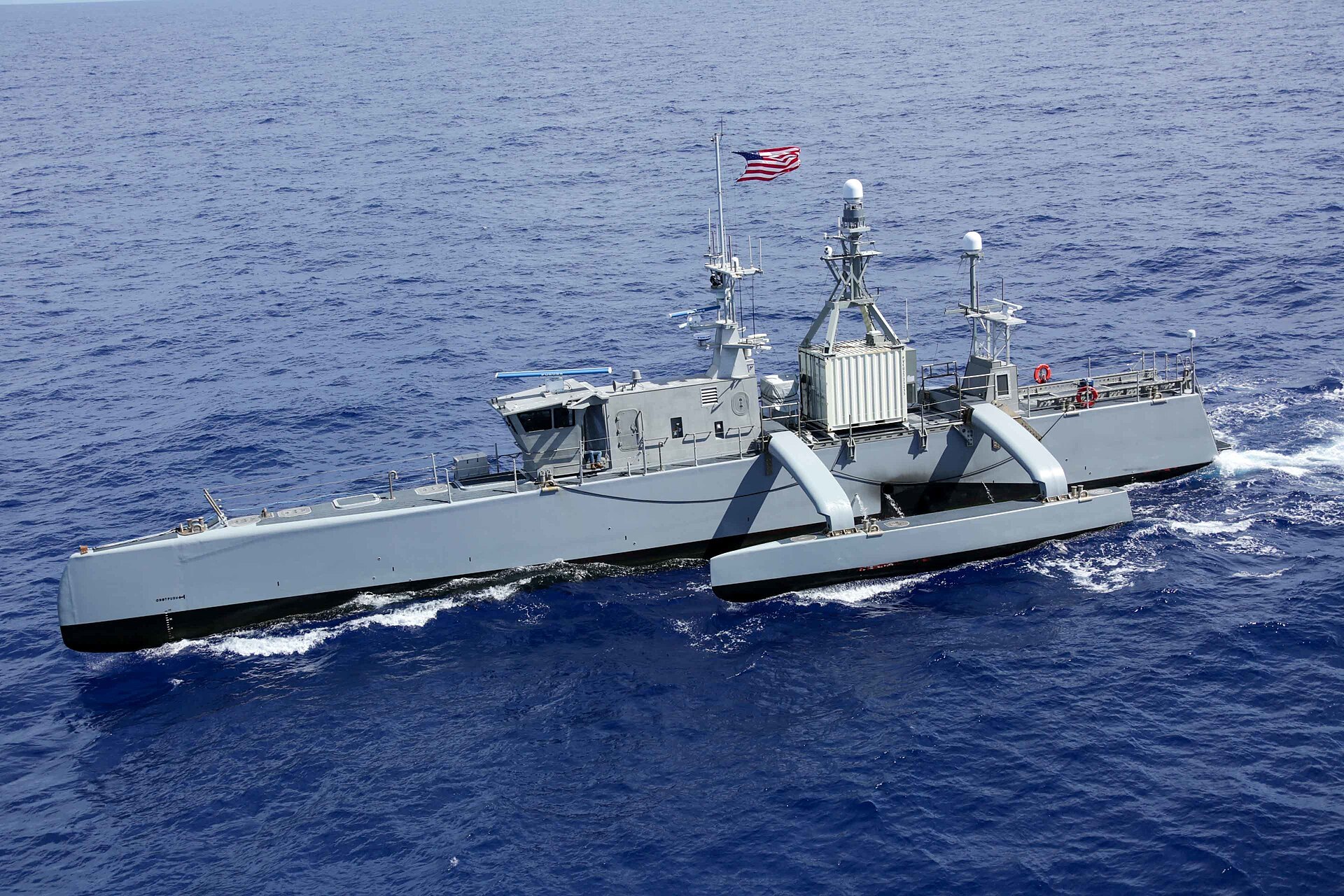
Photo details
File photo: Sea Hunter in the Pacific during RIMPAC on July 28, 2022. This earlier unmanned vessel is not one of the 30 ships in the 2026 agreements. Credit: U.S. Navy / Mass Communication Specialist 3rd Class Aleksandr Freutel.The timetable applies to the first vessels. The announcement does not specify when all 30 will be delivered or disclose a separate price for each builder’s agreement. [S1]
Louisiana hull construction preceded the awards
HII had already reported physical progress in Louisiana. In a September 8 update, the company said it and Breaux Brothers Enterprises had completed the structure of the first ROMULUS 151 hull in New Iberia and turned it upright. That step cleared the way to build its deck and pilothouse. At that point, HII said five ROMULUS 151 vessels were under construction: four at Breaux Brothers and one at Halimar Shipyard in Morgan City. Those were construction milestones, with further work still identified in the company’s account. [S3]
Regional shipbuilders support the autonomy program
In its September 29 announcement, HII confirmed that its award covers 10 ROMULUS vessels. The company described a production network involving Breaux Brothers, Halimar and Bayou Metal Supply & Manufacturing in Louisiana. Its approach allows major components and assemblies to be made before final vessel integration, according to HII. The company says it began securing partners, suppliers, capacity and infrastructure for ROMULUS construction in 2025. [S2]
That shipbuilding network supports a separate technology task: integrating autonomy into the vessels. HII describes its Odyssey control architecture as enabling vessels to perceive their surroundings, navigate, manage onboard systems and payloads, and coordinate with other platforms with limited human intervention. These are the company’s descriptions of the system’s functions. [S2]
Sea trials lead to further integration and delivery
The Navy says Phase I examined maritime awareness, autonomous navigation under international collision-prevention rules and long-duration missions. HII separately reported that its autonomy system completed a 420-nautical-mile mission simulation in 28 hours. The company says its Navy-monitored evaluation ran for 13 days; these figures describe that testing, rather than a record of sustained fleet service. [S1] [S2]
The Navy also released a second-phase integration and testing call on September 23 to broaden future offerings. For the 30-vessel purchase, the next delivery checkpoint is the scheduled first handover before fiscal 2027 ends. HII’s five-hull update documents manufacturing activity. The announcements do not establish whether those hulls are among its 10 awarded vessels. [S1] [S2] [S3]
Sources and reporting scope
Reported from the linked primary documents with AI assistance and separate editorial reviews. No interviews, site visits or independent equipment tests were performed. Company statements are attributed; announced plans and research objectives are not completed results.
- S1: U.S. Navy, Direct Reporting Program Manager for Robotic and Autonomous Systems — accessed 2026-10-15
- S3: HII — accessed 2026-10-15
- S2: HII — accessed 2026-10-15