A team route remains after the abstract deadline
An organization that did not submit an abstract to DARPA’s Resilient program can still participate in a full proposal as a subcontractor or team member. The Defense Advanced Research Projects Agency confirmed that route in its October 5, 2026, frequently asked questions, with a condition: the prime applicant must have submitted a conforming abstract. [S3]
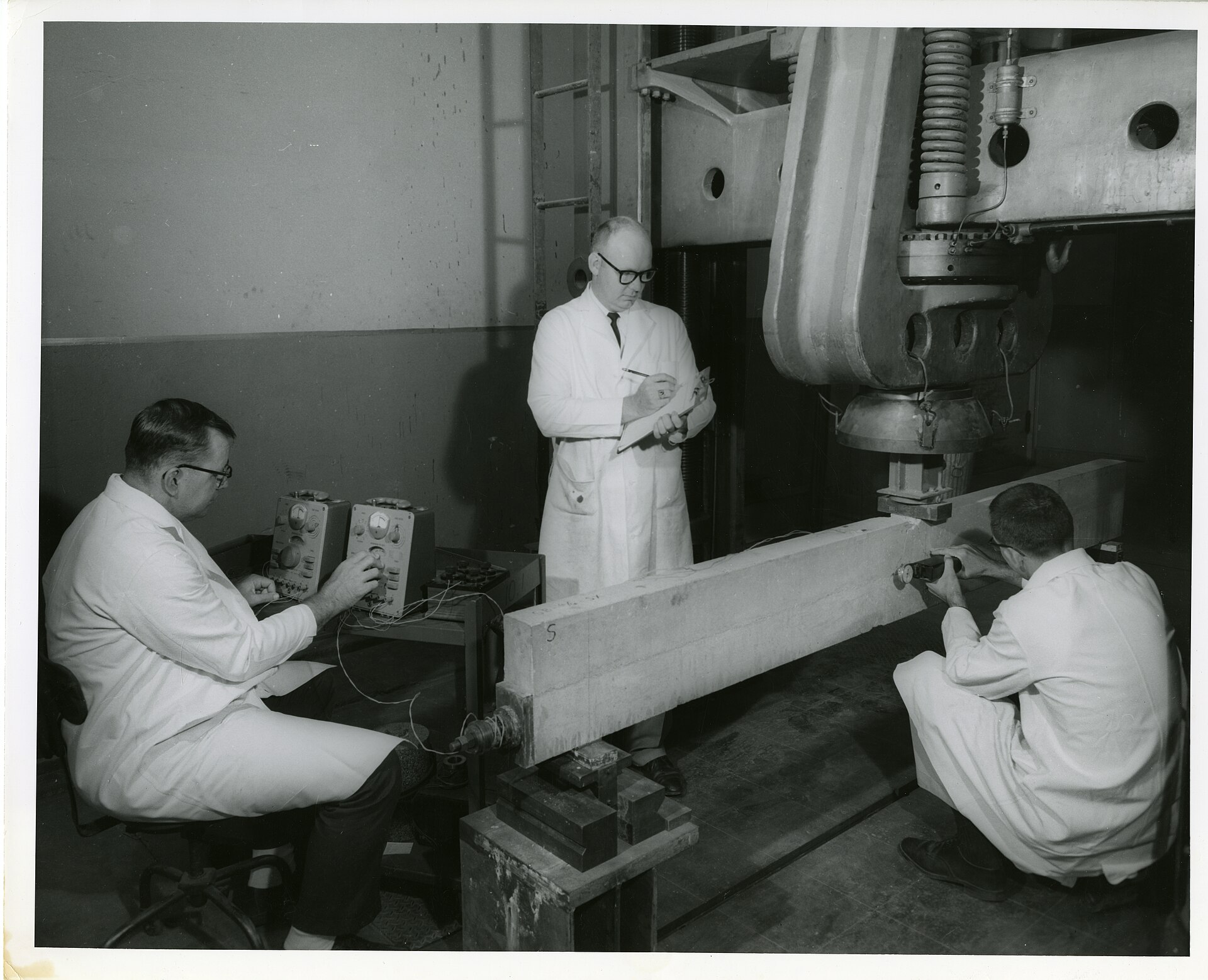


Photo details
Archive photo: structural testing of concrete at NIST. The source does not specify a date. This is historical context, not a photograph of DARPA’s Resilient program. Credit: National Institute of Standards and Technology.Resilient required those abstracts by September 9. The clarification gives potential partners a way to contribute to a qualifying proposal team as the October 19 deadline approaches. It does not reopen the abstract round or remove the prime applicant’s earlier submission requirement. [S2] [S3]
The infrastructure problem behind Resilient
DARPA describes a durability problem affecting military and civilian concrete infrastructure. Fast laboratory tests provide an incomplete picture, while observing structures in the field takes much longer. The agency says conventional approaches miss the combined effects of changing loads, chemicals entering concrete and repeated temperature changes. [S1]
Resilient seeks to connect physical testing with computer models that translate damage in small samples into predictions about full structures. The intended benefit is a better basis for forecasting how long concrete infrastructure will remain usable. That capability is a research ambition, rather than a result established by the announcement. [S1] [S2]
Faster aging must reflect real degradation
The program’s target is an integrated system that accelerates concrete aging by more than 1,000 times while preserving the degradation mechanisms seen in real-world data. Researchers are being asked to develop and demonstrate that capability. A rapid test must still tell a credible story about long-term performance. [S2]
Historical records are another required contribution. Proposers must bring concrete degradation data from prior research or public repositories. DARPA plans to combine selected teams’ records into a shared database for checking the models; its FAQ says the agency will not supply a standard dataset at the start. [S3] [S2]
Funding and eligibility have conditions
For each project, the combined award value is capped at $2 million, with up to $1 million for the base phase and $1 million for an optional second phase. Those totals include any required or proposed performer cost share. Meeting first-phase targets does not guarantee a second-phase award. [S2]
The broader Disruptioneering announcement permits responsible sources capable of meeting DARPA’s needs to propose, subject to its conditions. Resilient also has specific participation rules for federally funded research centers, university-affiliated research centers and government laboratories. Prospective partners need to check the requirements for their proposed role. [S4] [S2]
Use the amended package and finalize the submission
Teams should consult solicitation DARPA-PA-25-07-04, its September 4 Amendment 1, the current Disruptioneering announcement and the October 5 FAQ. Eligible primes submit through DARPA’s Broad Agency Announcement Portal by October 19, 2026, at 4 p.m. Eastern Daylight Time. DARPA requires the upload to be finalized and completed before the cutoff. [S2] [S3] [S4]
For organizations considering a team role, the practical starting point is a specific contribution to a qualifying prime’s proposal: stronger modeling, physical testing or usable historical data. DARPA’s clarification preserves that opportunity while keeping the original abstract requirement in place. [S1] [S2] [S3]
Sources and reporting scope
Reported from the linked primary documents with AI assistance and separate editorial reviews. No interviews, site visits or independent equipment tests were performed. Company statements are attributed; announced plans and research objectives are not completed results.
- S3: Defense Advanced Research Projects Agency — accessed 2026-10-15
- S2: Defense Advanced Research Projects Agency via SAM.gov — accessed 2026-10-15
- S1: Defense Advanced Research Projects Agency — accessed 2026-10-15
- S4: Defense Advanced Research Projects Agency via SAM.gov — accessed 2026-10-15