
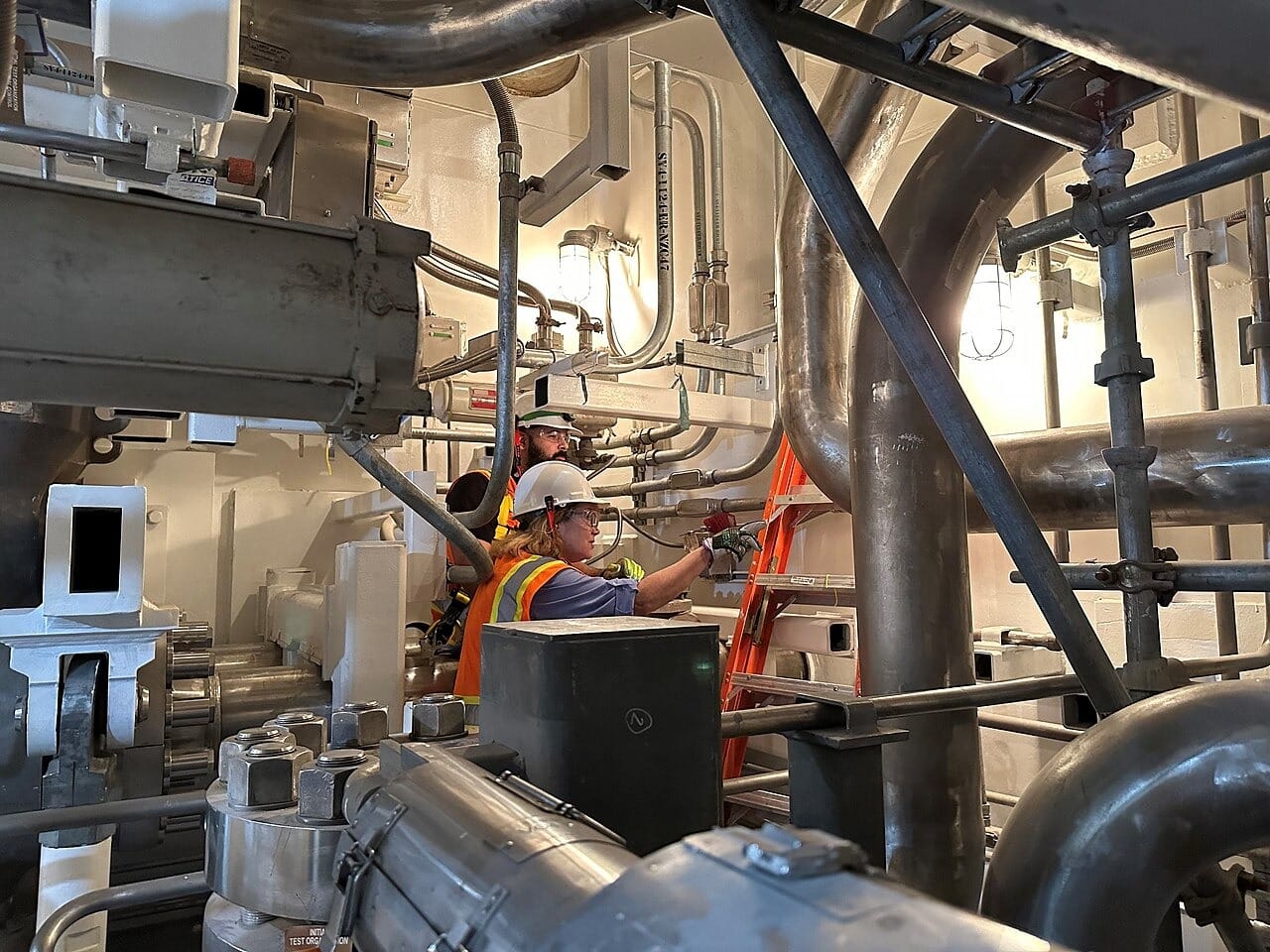

Vogtle Unit 4 had already sent electricity to the grid before April 29, 2024. What changed that day was its status: Georgia Power declared the reactor in commercial operation, completing the two-unit expansion of the nuclear plant near Waynesboro, Georgia.
The distinction is more than ceremonial. Initial grid connection in March belonged to the startup process. Commercial service marked the point at which the company placed the unit into its operating fleet. The U.S. Energy Information Administration described Unit 4 as a 1,114-megawatt reactor, a large addition concentrated in one generating unit.
It was not a new four-reactor plant opening all at once. Vogtle's first two units began operating in 1987 and 1989. Unit 3 joined them in July 2023; Unit 4 completed the expansion nine months later. Georgia Power's forecast of more than 30 million megawatt-hours annually referred to the entire four-unit site, not the new reactor alone.
That distinction also prevents a misleading comparison between power and energy. A megawatt rating describes generating capacity. Annual megawatt-hours describe electricity produced over time, which depends on operation. The forecast for the whole site was an expectation at completion, not a measured result for Unit 4's first year.
The expansion had taken much longer and cost much more than planned. EIA's contemporary account put the original project expectation at approximately $14 billion, with Units 3 and 4 intended to enter commercial operation in 2016 and 2017. By completion, the agency reported a project estimate exceeding $30 billion. Those figures concerned the two-reactor expansion across its owners.
A separate, smaller number governed Georgia Power's recovery of construction and capital costs from its customers. In December 2023, the Georgia Public Service Commission approved an agreement limiting that recovery to $7.562 billion. The commission contrasted the figure with the $10.75 billion Georgia Power then expected to spend bringing the project to completion.
The $7.562 billion was therefore neither the cost of Unit 4 nor the total cost of the expansion. It described a particular regulated recovery amount for one owner. Comparing it directly with the expansion's overall estimate would mix different financial boundaries and obscure who bore which costs.
Ownership was divided among Georgia Power, Oglethorpe Power, MEAG Power and Dalton Utilities, with Southern Nuclear operating the plant on their behalf. A generating asset shared by several utilities does not translate into a single uniform retail bill: the owners have different customers and financial arrangements.
Completion also shifted the practical test from building the reactor to sustaining its performance. The state commission said on April 29 that it would continue monitoring the units to ensure they operated as designed. Georgia Power described a prospective operating contribution lasting decades; realizing that value would require continued safe operation and maintenance.
For the grid, April's outcome was concrete: the second new reactor entered commercial service. For customers and future nuclear projects, the history remained consequential. Vogtle demonstrated that a large expansion could be finished, while its schedule and financing record showed why operational capacity and the cost of obtaining it must both remain in the account.
Sources
- Vogtle Unit 4 enters commercial operation — Georgia Power · 2024-04-29.
- Plant Vogtle Unit 4 begins commercial operation — U.S. Energy Information Administration · 2024-05-01.
- Commissioners approve agreement for Vogtle construction costs — Georgia Public Service Commission · 2023-12-19.
- Vogtle Unit 4 in Commercial Operation — Georgia Public Service Commission · 2024-04-29.