
Photo details
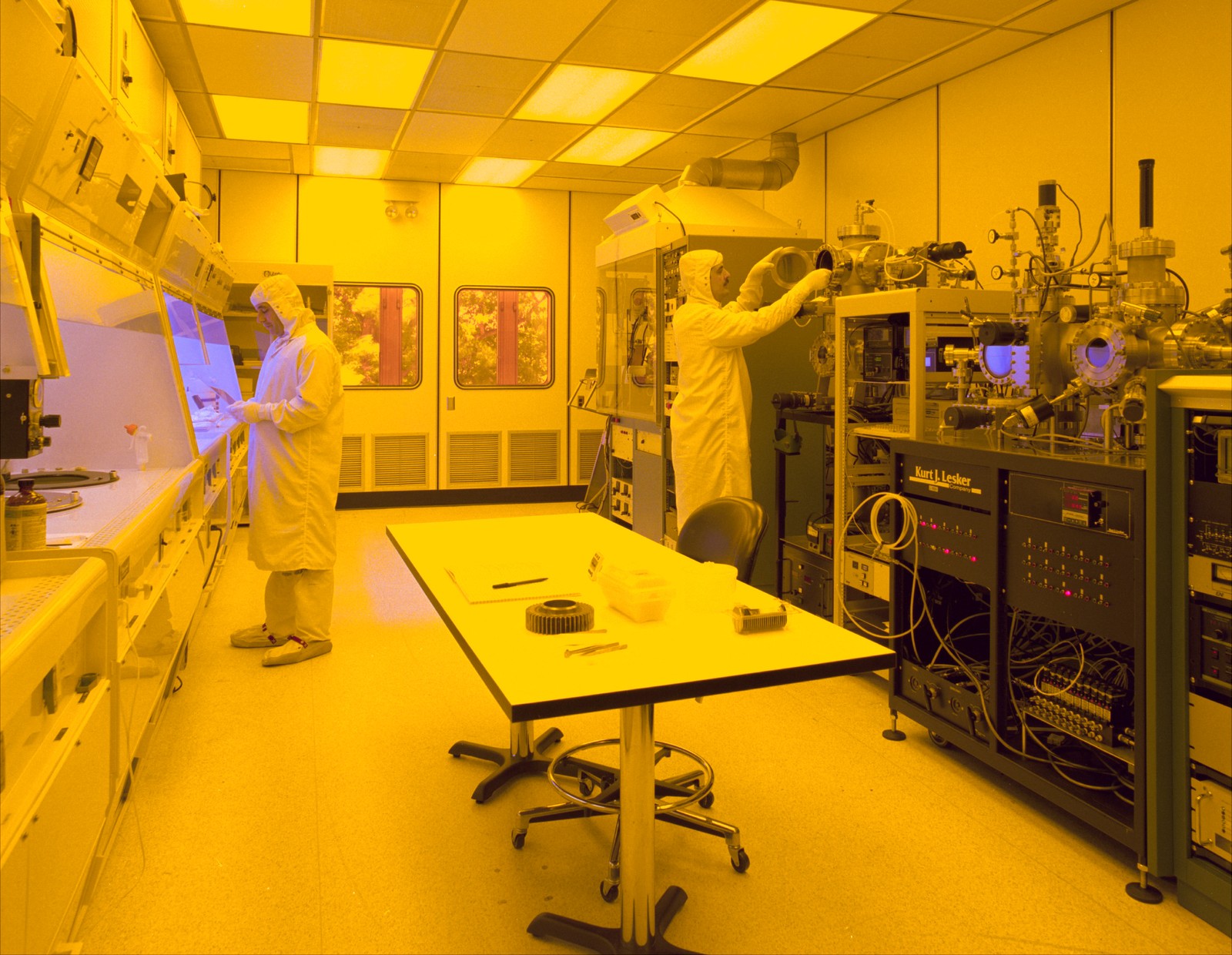
Contextual chip-fabrication photograph; it does not depict the reported microcomb, experiment or research team. NASA Glenn Research Center image GRC-1998-C-01261. Commons lists May 1, 2004; the supplied evidence does not independently confirm the capture date or identify the facility location. Credit: NASA; Commons upload by Duk, with color-balance edits recorded by Jacek Halicki. The archived item-specific statement establishes public-domain status in the United States. Source: the linked source record Resized for publication; no scene content was added or removed.Researchers at the National Institute of Standards and Technology (NIST) and their collaborators used the same miniature light ruler to generate calibrated optical frequencies, produce low-noise millimeter waves and read an optical clock reference. Their Nature paper, published September 30, 2026, reports a calibration advance that helped make this versatility possible: the same microcomb handled all three jobs by changing how its two input lasers were controlled.
NIST's October 16 announcement identified mobile timekeeping and navigation during GPS outages or jamming as potential applications. It followed the Joint Quantum Institute's October 5 explanation of the same collaboration's work. The demonstrated advance concerns the measurement machinery needed for such systems. Although the new approach simplifies calibration, the experiment retained external lasers, feedback controls and equipment for reading the chip's fast signals.
An optical clock ties laser light to the behavior of atoms. The light oscillates too rapidly for electronics to count directly. A frequency comb supplies a series of precisely spaced optical frequencies, called teeth, that connects those rapid oscillations to slower microwave signals. This connection allows the stability of an optical reference to reach the electronic systems that track time.
Even spacing alone does not make the comb an absolute frequency ruler. Researchers must also know how far its grid is shifted from zero frequency. Without that offset, knowing the intervals between teeth does not establish the exact frequency of each tooth. Both the spacing and the offset must be known and controlled.
That calibration has been a difficult step for miniature combs. Conventional designs use one driving laser, or pump, and generate additional frequencies outward from it. Teeth toward the edges become weaker and noisier. The standard offset measurement requires usable signals separated by approximately an octave, meaning one frequency is roughly twice the other. When those widely separated signals are too weak or unstable, researchers need additional equipment, complicating efforts to shrink the system.
The reported advance forms a comb between two pump lasers separated by roughly an octave. Their light circulates through a tiny ring made of silicon nitride, interacting through the material to generate additional frequencies. Those interactions also align otherwise offset groups of teeth into one frequency grid that includes both pumps. This self-alignment makes the strong input laser signals part of the calibrated ruler.
Because the pumps belong to that grid, their relationship determines the comb's zero-frequency offset. Researchers can measure it on the input side of the chip by doubling one pump's frequency and comparing it with the other. Feedback stabilizes the relationship. The approach moves the calibration measurement to strong input signals, avoiding dependence on faint edge teeth, while retaining frequency-doubling optics and electronic controls.
In the first measurement task, the team used a microwave frequency standard to set the comb's tooth spacing and offset. They then checked selected optical teeth with a conventional fiber comb. The measurements agreed with frequencies expected from those settings. This is optical-frequency synthesis: establishing known frequencies of light from an electronic reference.
The second task reversed the direction. A low-noise laser reference supplied optical light, and the microcomb transferred its stability into lower-frequency millimeter-wave signals. Dividing optical frequencies down reduces the fluctuations carried into that output. This tested the comb's ability to produce low-noise signals from an optical reference using the same device that had performed frequency synthesis.
For optical-clock readout, the team used a laser tied to a rubidium atomic reference. The comb transferred that reference's long-term stability to its pulse repetition rate—the rate at which pulses recur. Measuring that rate allowed the apparatus to determine the optical reference's frequency. The atoms supplied the timing standard; the comb provided the connection to electronics.
The clock-frequency estimates from the microcomb and the team's conventional fiber comb differed by about 3 kilohertz. That was within the microcomb measurement's reported standard deviation of approximately 26 kilohertz over 75 minutes. The standard deviation describes the spread in the readings, giving context for judging the difference between the instruments.
Both readouts were offset from the published value for the atomic reference. The authors attributed that shared shift to systematic effects in the rubidium apparatus. Agreement between the instruments supports the microcomb's readout function without establishing equivalent absolute accuracy. This was the collaboration's own comparison, not independent replication of its results.
The fabrication results offer another bounded measure of progress. All 10 devices sampled across a 100-millimeter wafer produced self-aligned combs, despite deliberately different coupler designs—the structures that transfer light into and out of the rings. The paper identifies Ligentec as the commercial silicon nitride foundry. These results demonstrate tolerance across the tested devices; they do not establish the proportion of working devices across an entire production run.
A remaining hardware requirement lies in reading the comb's output. Its high repetition rate required a phase-modulator apparatus for downconversion: bringing a fast signal into a lower frequency range that the measurement electronics could handle. Simplifying the offset measurement did not remove that apparatus. The demonstrated system therefore combined a miniature comb with external equipment needed to extract a useful electronic signal.
The paper and institutional updates through October 16, 2026 do not report a complete field-ready optical clock or a deployed GPS replacement. To advance toward portable operation, the authors propose further integration, including compact comb or electro-optic technology for another stage of frequency division. That proposed stage would address a concrete remaining requirement: making the chip's fast output readable with a more compact system.
Sources
Reported from public primary documents with AI assistance, independent source retrieval, and separate editorial reviews. No interviews, site visits or equipment tests were performed. Issuer statements retain attribution; announced plans are not completed results.
- S1: www.nist.gov — accessed 2026-10-19
- S3: hub.jqi.umd.edu — accessed 2026-10-19
- S2: jqi.umd.edu — accessed 2026-10-19
- S4: www.nist.gov — accessed 2026-10-19