
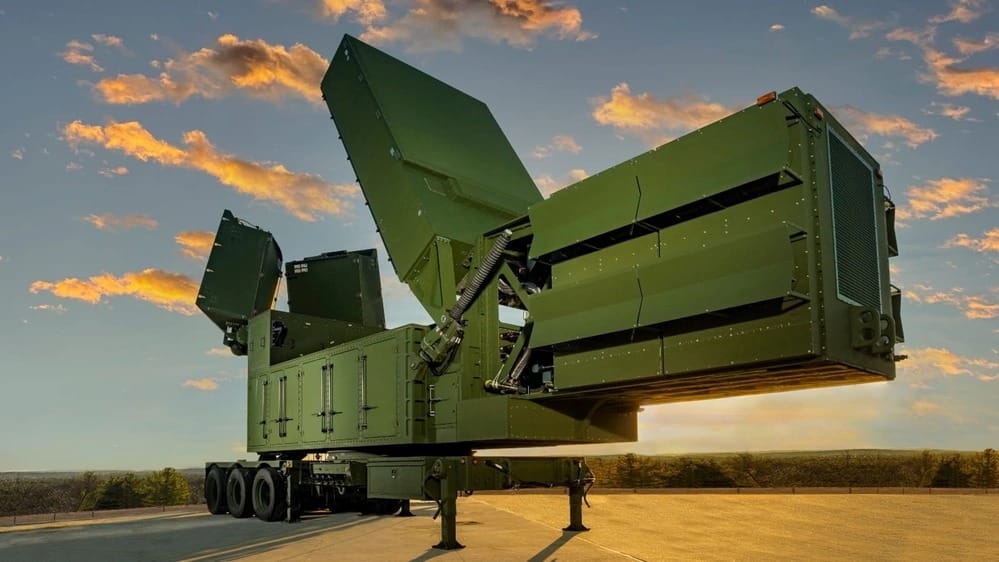

A new air-defense radar can pass the gate into production while still needing substantial work before soldiers can move, maintain and operate it reliably. The Army’s Lower Tier Air and Missile Defense Sensor reached that point in 2025.
Raytheon announced on April 21 that LTAMDS had received Milestone C approval, opening the production and deployment phase of the acquisition program. The transition gave the Army and industry a basis for building beyond the prototype effort. It did not settle every question about the radar’s operational performance.
LTAMDS is intended to provide surveillance around the full circle, helping air defenders address threats arriving from different directions. Raytheon describes it as an electronically scanned radar using gallium-nitride technology. It is part of a larger defensive system: detecting and tracking a target has to connect with battle management, launchers and interceptors before a missile can be engaged.
The manufacturing effort was already substantial. In April, Raytheon said it had delivered the first six radars funded under its 2019 contract. The company described production running at eight additional radars a year and an expansion toward 12. That higher figure was a ramp-up objective, rather than a demonstrated annual delivery total.
The international customer mattered to the production plan. Poland was the first foreign buyer, giving the program demand beyond the U.S. Army. In a September 23 announcement, RTX described a $1.7 billion Army contract covering nine radars for the two countries, together with engineering, spare parts, support, development and testing. The package’s stated value therefore cannot be treated as nine standalone radar prices or as proof that nine systems had been delivered.
Raytheon’s April announcement emphasized eight successful flight tests. Government test reporting subsequently supplied a more qualified account of what the program had established.
The Director, Operational Test and Evaluation’s report covering fiscal 2025 confirmed the April production milestone. It also explained that operational assessment data provided insight into effectiveness against aircraft-like threats, while insufficient data were available to assess operational effectiveness against tactical ballistic missiles. Four developmental missile flight tests during the fiscal year demonstrated capabilities outside an operational setting and were not used for that operational-effectiveness assessment.
The same report identified low reliability and excessive time needed to set up and move the radar. Some environmental and transportability requirements remained unmet. Those findings bear directly on whether a unit can keep the equipment working and relocate it when required, beyond the question of whether it can detect a target during a test.
The production transition thus committed the program to a larger manufacturing effort while development and evaluation continued. The later government report placed the full-rate production decision at the end of fiscal 2028, nearly a year later than an earlier test plan had shown. For the 2025 milestone, the consequential next result was whether the radars emerging from that production effort would resolve the operating problems identified in testing.
Sources
- RTX’s Lower Tier Air and Missile Defense Sensor positioned for production — RTX · 2025-04-21.
- RTX awarded $1.7 billion contract for LTAMDS — RTX · 2025-09-23.
- FY2025 Annual Report, LTAMDS section — Director, Operational Test and Evaluation.