
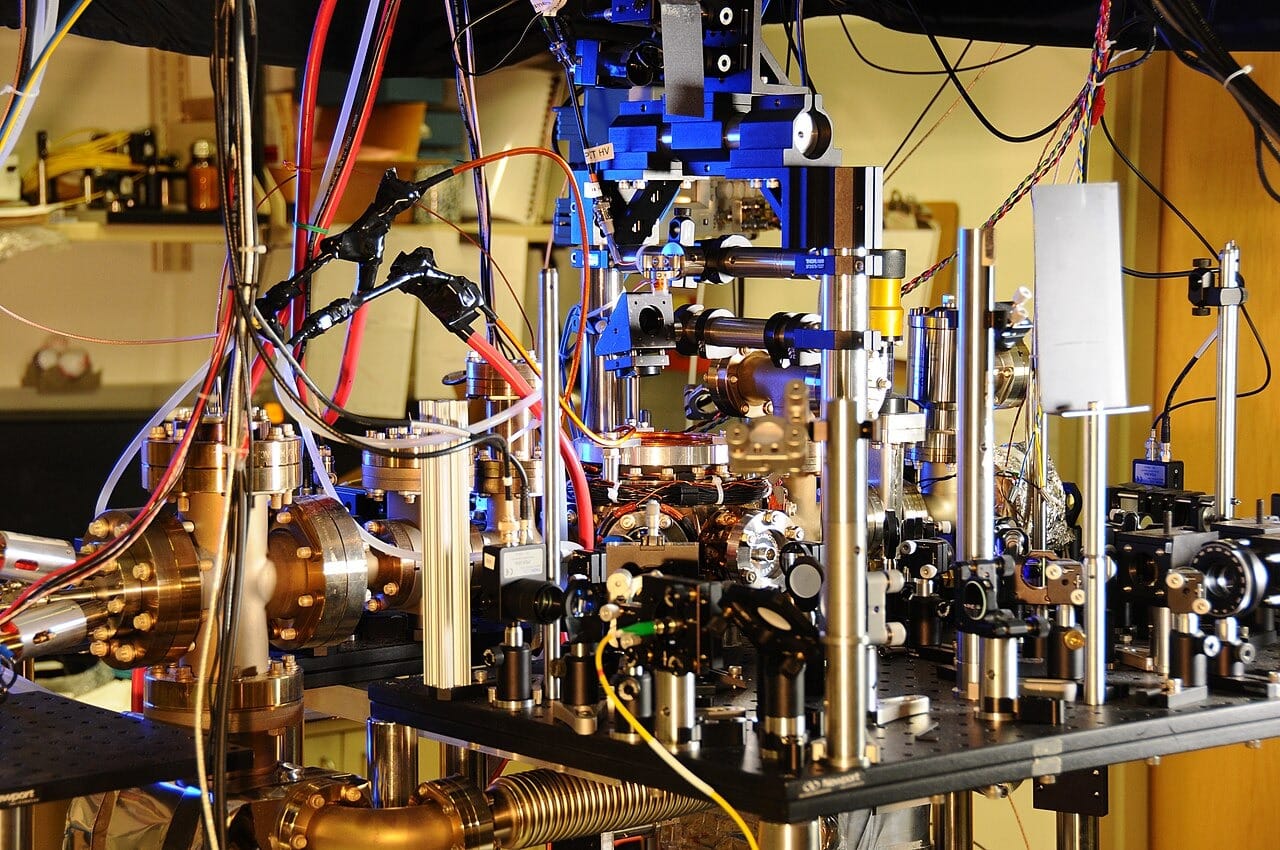

A clock can be extraordinarily accurate and still take an inconveniently long time to prove it. In July 2025, a NIST team reported progress on both problems: a single-ion optical clock with lower measurement uncertainty and a much shorter wait for a precise result.
The paper, published July 14 in Physical Review Letters, reported fractional frequency uncertainty of 5.5 × 10⁻¹⁹. That number describes uncertainty in the clock's frequency, not the resolution of a display. NIST also reported that reaching the nineteenth decimal place through averaging took about a day and a half, compared with three weeks for the earlier arrangement.
The distinction matters for a laboratory. Systematic uncertainty concerns the effects that can shift a measurement away from the desired value. Stability concerns its fluctuations over time. A clock needs both: waiting longer can reduce random noise, but it cannot automatically correct a persistent physical bias.
The instrument used an aluminum ion alongside a magnesium ion. The magnesium provided cooling and a way to read out the aluminum clock transition through quantum logic spectroscopy. The published research identified improvements in three linked parts of the apparatus: the electrical design of the trap, the vacuum surrounding the ions and the laser used to interrogate them.
Those are tangible engineering constraints. An ion held in a trap can still undergo unwanted motion; a residual gas molecule can collide with it. The researchers' improved trap reduced excess micromotion, while the new vacuum system reduced collision-related shifts. Better control of those effects lowered uncertainty rather than merely producing a longer sequence of measurements with the same weaknesses.
For the laser, the team reached beyond its own room. A 3.6-kilometer optical-fiber connection transferred stability from a remote cryogenic silicon cavity. The arrangement allowed a one-second interrogation, the paper reported. NIST's account described how a frequency comb connected the aluminum-clock laser with the exceptionally stable laser at JILA, the joint NIST–University of Colorado Boulder institute.
This was a useful example of research infrastructure functioning as a network. A highly stable reference could improve another instrument without every laboratory having to reproduce the entire reference system beside its own experiment.
A separate NIST review published in May 2025 set out why distributing optical time and frequency matters. Such techniques support comparisons between optical clocks, tests of fundamental physics and timing for large scientific instruments. They also support relativistic geodesy, in which precise frequency comparisons help study gravitational potential. The review described a field moving from development of techniques into applications.
The July result did not itself redefine the second or replace the clocks behind everyday time services. Its contribution was a stronger experimental platform for that longer effort, with measurements that could be completed sooner and with smaller identified errors.
That shorter measurement cycle had practical scientific value. Researchers could spend less of an experiment waiting for noise to average away and more time making the comparisons their questions required. At the frontier of timekeeping, improving the clock also improved the pace of the work around it.
Sources
- High-Stability Single-Ion Clock with 5.5 × 10⁻¹⁹ Systematic Uncertainty — Physical Review Letters · 2025-07-14.
- NIST Ion Clock Sets New Record for Most Accurate Clock in the World — NIST · 2025-07-14.
- High-Precision Optical Time and Frequency Transfer — NIST · 2025-05-02.