

A camera weighing three metric tons still had to worry about deviations smaller than a human hair. When SLAC National Accelerator Laboratory announced completion of the LSST Camera on April 3, 2024, its size was spectacular. Its precision was the harder story.
The 3,200-megapixel instrument was destined for Vera C. Rubin Observatory in Chile. Construction had taken two decades. At the announcement, shipment, testing at the observatory and installation on its telescope remained ahead. Finishing the camera was a major hardware milestone within a larger project, rather than the start of the planned ten-year sky survey.
Rubin’s intended scientific advantage was repetition. The camera would photograph the southern night sky again and again, creating a record of objects that moved, brightened, faded or otherwise changed. The same observing program would support studies ranging from nearby solar-system objects to distant galaxies. That placed a demanding combination of requirements on the instrument: broad coverage, fine detail and the ability to get ready for the next exposure quickly.
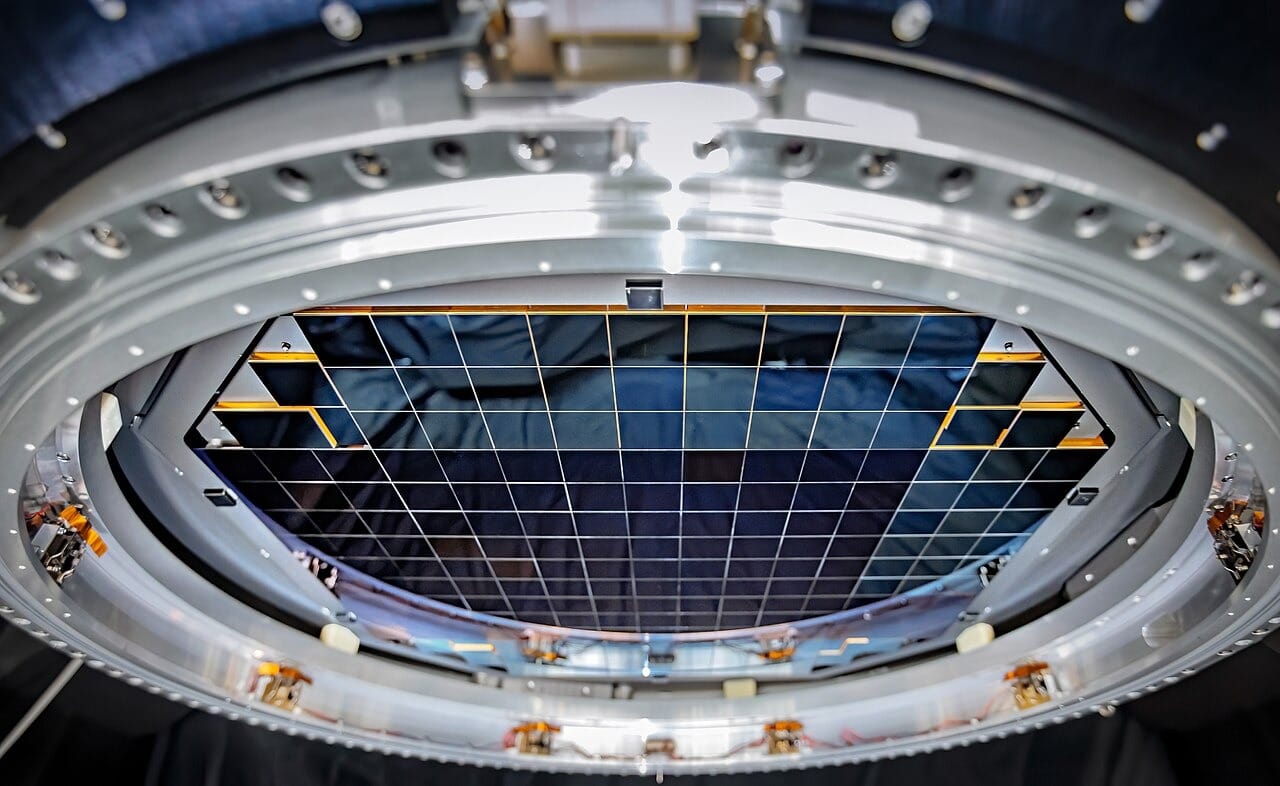
Inside the camera, light would become electrical charge in silicon sensors. Brookhaven National Laboratory built the sensor array as a mosaic: 189 sensors for scientific imaging, plus another 12 for guiding and focusing. The science sensors were grouped into 21 modules containing nine sensors apiece. This arrangement let engineers test individual modules before integrating the whole focal plane.
The gaps and alignment mattered. Brookhaven specified separations no greater than 250 microns between adjacent sensors and exceptionally tight limits on tilt. A mosaic gives engineers a practical way to assemble a large detector, but its pieces must still behave as one imaging surface. Poor alignment can squander the quality of the optics delivering light to it.
Reading the image posed another constraint. A huge detector that spent minutes transferring every exposure would lose valuable observing time. Brookhaven’s design divided each sensor’s signal among 16 independent readout segments, producing more than 3,000 channels across the imaging surface. Parallel electronics were designed to reduce full-image readout to about two seconds. More pixels demanded more routes out of the camera, as well as more collecting area within it.
The optics carried their own mechanical burden. SLAC described a front lens more than five feet across and another roughly three feet wide that also sealed the focal plane’s vacuum chamber. That second lens had to maintain its optical shape while performing a structural job. The assembled detector surface, meanwhile, had to remain extraordinarily flat.
These requirements served measurements more delicate than simply locating a bright object. One planned investigation would use subtle distortions in distant galaxies’ apparent shapes to study the intervening distribution of matter. An instrument intended to measure small differences must control the differences it creates itself.
Completion therefore meant that a collection of specialized detectors, lenses and electronics had become an integrated camera. The April announcement closed that construction chapter. Transporting the instrument to Cerro Pachón and making it work with the telescope would determine whether those carefully assembled capabilities could become a sustained stream of astronomical measurements.
Sources
- SLAC completes construction of the largest digital camera ever built for astronomy — SLAC National Accelerator Laboratory · 2024-04-03.
- Digital Sensor Array — Brookhaven National Laboratory.
- Rubin’s LSST Camera is Complete — Rubin Observatory · 2024-04-03.