
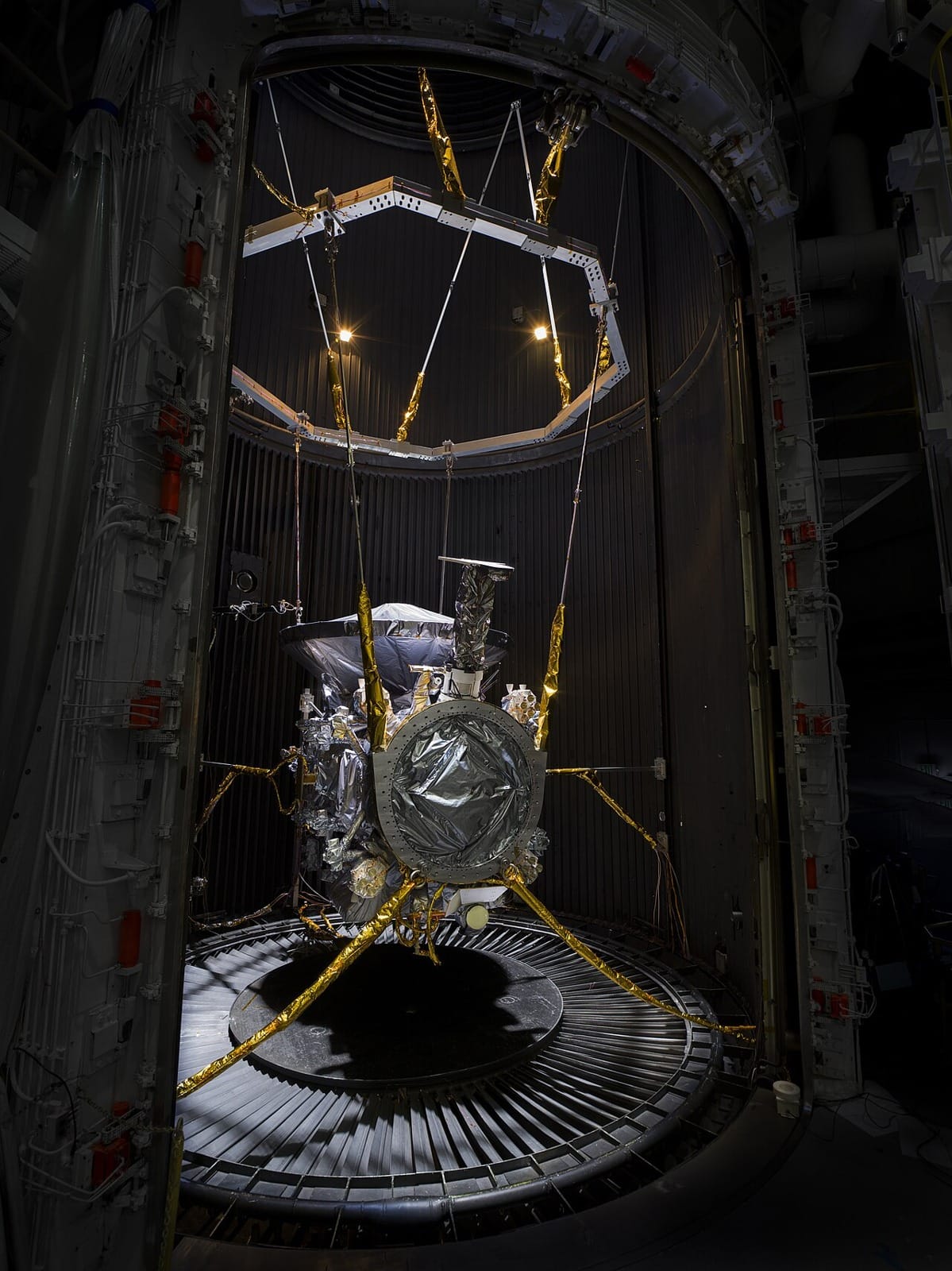

Europa Clipper's destination demanded a spacecraft that could collect weak sunlight while protecting itself from intense radiation. The mission that launched October 14, 2024, carried both solutions: enormous solar wings and a plan to visit Europa repeatedly without remaining in orbit around the moon.
A SpaceX Falcon Heavy lifted the NASA spacecraft from Kennedy Space Center at 12:06 p.m. EDT. Roughly an hour later, Clipper separated from the rocket, and controllers established two-way communication through the Deep Space Network station in Canberra, Australia. The launch began a journey intended to reach Jupiter in April 2030, using planetary gravity assists along the way.
By that afternoon, controllers had confirmed deployment of both solar arrays. The wings had been held against the spacecraft for launch; releasing their restraints allowed them to unfold one at a time. Each extended about 14 meters. Opening them gave the spacecraft its power-collecting surface for the long cruise and the eventual observing mission.
Their size answered a physical problem. Jupiter is more than five times as far from the Sun as Earth, so the spacecraft needed a large collecting area to operate its instruments and electronics there. With the arrays deployed, Clipper extended about 30 meters end to end. The dimensions followed the power requirement of the destination.
Keeping the equipment at useful temperatures required another system. NASA's launch-day spacecraft description detailed fluid circulating through pipes to move heat from warmer electronics toward colder areas. Sensors, heaters, insulation and a radiator with adjustable louvers supported temperature control. Producing electricity and managing the heat of the machinery using it were related but separate tasks.
Radiation shaped the observing strategy. NASA's September 2024 mission account described a shielded electronics vault and looping orbits around Jupiter that would carry Clipper near Europa for less than a day at a time. It would then leave the strongest radiation region and return for another pass two to three weeks later. The planned science tour contained 49 close flybys.
That pattern traded continuous proximity for repeated opportunities to measure the moon. NASA planned to operate the instrument suite together during each pass, allowing different observations to be compared. The spacecraft carried nine instruments and a gravity experiment using its radio system. Its work was aimed at the ice shell, the material composing the moon and its geology, including their relationship to a suspected underlying ocean.
The scientific distinction was important: the mission sought to assess conditions that could support life. Launching an observatory did not establish that Europa was inhabited, and even a finding of habitable conditions would be different from detecting an organism.
What October 14 established was more immediate. The spacecraft had departed Earth, communicated with its operators and opened the arrays needed to sustain it. Its much later investigation depended on keeping that complex combination of power, thermal control, shielding, navigation and instruments working together. The flight plan showed how an ambitious scientific question could be broken into a sequence of visits the machinery had a chance to survive.
Sources
- Liftoff! NASA’s Europa Clipper Sails Toward Ocean Moon of Jupiter — NASA · 2024-10-14.
- Solar Arrays on NASA’s Europa Clipper Fully Deployed in Space — NASA · 2024-10-14.
- Meet NASA’s Europa Clipper Spacecraft — NASA · 2024-10-14.
- 8 Things to Know About NASA’s Mission to an Ocean Moon of Jupiter — NASA · 2024-09-17.