
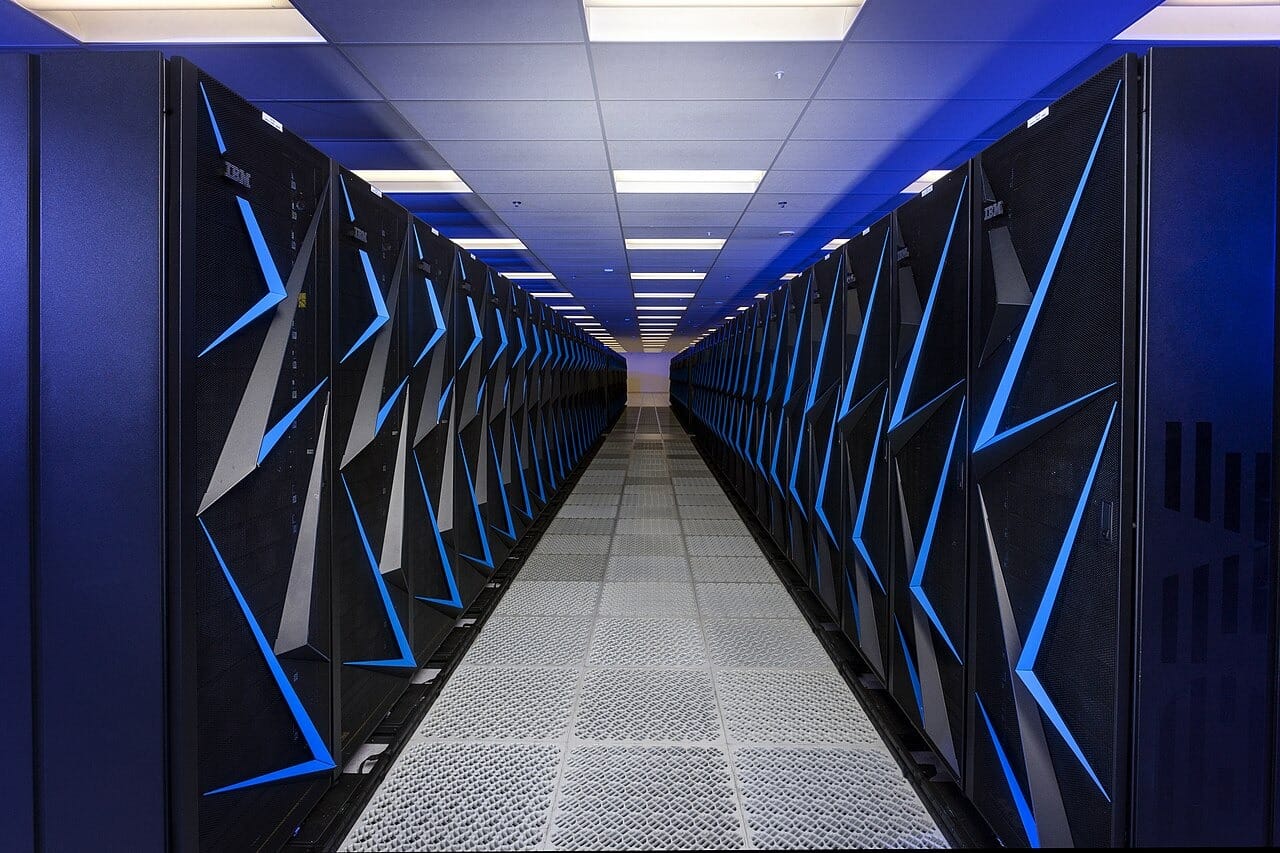

El Capitan had already won the speed contest when employees, officials and industry partners gathered to dedicate it on January 9, 2025. The next challenge was turning an exceptional benchmark result into a computing resource scientists could use for sustained work.
The Lawrence Livermore National Laboratory ceremony marked acceptance and deployment of the National Nuclear Security Administration’s first exascale system. Built with Hewlett Packard Enterprise and AMD, it served the computing mission shared by Livermore, Los Alamos and Sandia national laboratories. Its central purpose was high-fidelity modeling and simulation for national security.
The chronology matters. El Capitan reached the top of the TOP500 list in November 2024, with 1.742 exaFLOPS on the High Performance Linpack benchmark. That meant about 1.742 quintillion floating-point operations per second on a defined mathematical test. The system’s theoretical peak was higher, at 2.79 exaFLOPS.
Neither number promised that every scientific application would run at that rate. Benchmarks allow consistent comparison between machines; applications have their own demands for memory, communication, data movement and calculation. A research team cares about how much useful work a complete simulation can accomplish, including the time spent moving and storing its data.
El Capitan’s design addressed several parts of that problem together. Its AMD MI300A processors combined CPU and GPU computing with high-bandwidth memory in a shared package. HPE supplied the system architecture and interconnect. Livermore’s technical account also described liquid cooling and a storage hierarchy connecting fast local storage to a shared file system.
This was an entire computing installation, not simply a purchase of faster chips. More than 11,000 compute nodes had to operate as a coordinated system. Software had to make productive use of them, and the laboratory had to manage the machine as a service for demanding scientific workloads.
The January dedication acknowledged that institutional effort. Livermore’s account credited contributors beyond the computer engineers, including procurement, legal and construction staff. Such work is easy to lose behind the headline arithmetic, but a large scientific instrument cannot be accepted, installed and operated through processor performance alone.
A later primary record supplied a useful endpoint for the 2025 retrospective. NNSA’s performance evaluation, dated December 12, stated that El Capitan entered production status in September after its transition to the classified network. The assessment concerned the laboratory operator’s performance over the fiscal year. It established an operational milestone distinct from both the 2024 ranking and the January ceremony.
For science, the potential gain extended beyond finishing an existing calculation sooner. More computing capacity can let teams examine additional cases, represent finer detail and test how sensitive a result is to assumptions. Those gains still depend on suitable models, reliable software and comparison with evidence. A larger machine expands what can be attempted; it does not make an uncertain model automatically correct.
El Capitan’s 2025 story thus had two recognizable moments: public dedication in January and production status in September. Between them lay the work that turns a national computing achievement into a working scientific facility.
Sources
- LLNL dedicates El Capitan, ushering in new era in supercomputing for national security — Lawrence Livermore National Laboratory.
- Lawrence Livermore National Laboratory’s El Capitan verified as world’s fastest supercomputer — Lawrence Livermore National Laboratory · 2024-11-18.
- Lawrence Livermore National Security, LLC: FY2025 Performance Evaluation Report — National Nuclear Security Administration · 2025-12-12.