
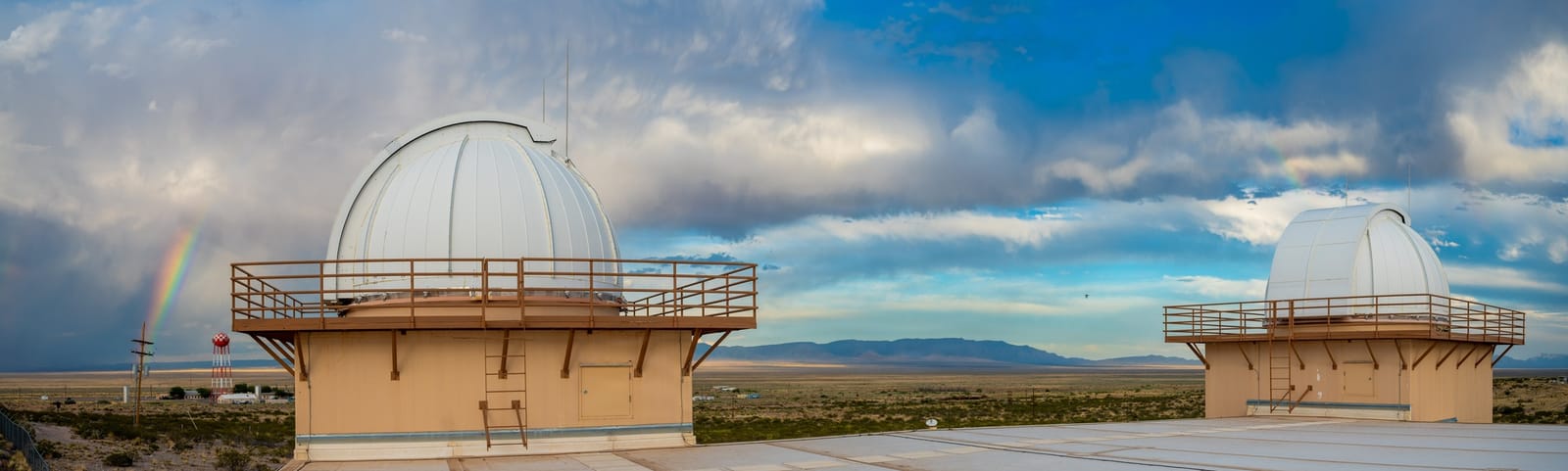
One of the clearest demonstrations of a space system’s vulnerability left the satellite itself unharmed. The recovery effort involved shipping nearly 30,000 modems.
On February 24, 2022, the day Russia began its full-scale invasion of Ukraine, a cyberattack disrupted part of Viasat’s KA-SAT broadband network. Several thousand customers in Ukraine and tens of thousands elsewhere in Europe were affected, according to the company’s subsequent account. Attackers reached a management network on the ground and disabled customers’ modems. Viasat found no evidence that the spacecraft itself had been impaired.
The United States, Britain and European allies later attributed the attack to Russia. British officials said the effects reached wind farms and internet customers in central Europe. Spacecraft destruction was unnecessary: disruption traveled through the equipment connecting people to the satellite.
That episode helps explain the challenge in the Defense Intelligence Agency’s newly released Challenges to Security in Space: Congestion, Competition, and Cooperation. Across 130 pages, including appendices and extensive source notes, the agency describes China’s growing ability to observe distant forces, Russia’s destructive weapons programs and the opportunities available to smaller powers. This third edition gives its information cutoff as July 2026. Its warnings concern capabilities accumulated over years, alongside systems still under development.
Read together with government audits and independent space research, the report poses an uncomfortable test for American strength. Can a military unit, an emergency responder or an infrastructure operator still obtain the information it needs when part of a space system fails? And can American industry restore the service before its absence changes the outcome?
China’s expanding fleet and weapons programs
China’s expansion makes those questions more urgent. DIA puts its intelligence, surveillance and reconnaissance fleet at more than 510 systems as of July, more than triple the 2018 number. These satellites collect photographs, radar images and electronic signals. Many have commercial or civilian affiliations, but DIA says their information can support military operations.
China’s launch count expanded

Read the graphic / Data and notes
| Year | Chinese launches |
|---|---|
| 2016 | 22 |
| 2025 | 93 |
These are two observations, not an intervening annual series. A launch count does not measure satellites, intelligence systems or military payloads. Source: DIA, Challenges to Security in Space (2026), printed p. 7. See the article’s Sources section for the report link.
Those figures describe two related advantages: more opportunities to observe events and more capacity to put equipment into orbit. They do not, by themselves, establish that China can continuously track every American ship or turn every observation into a successful strike. Detecting an object, identifying it, following its movements and delivering timely information to a military user remain separate tasks. More sensors can strengthen that chain without making it infallible.
DIA nevertheless sees a clear military purpose. It assesses that Beijing probably regards weapons against space systems as a way to discourage or prevent outside intervention in a regional conflict. China is developing its own ability to see farther while acquiring ways to interrupt the information on which American forces depend. The strategic danger is an unequal loss of awareness: one side still receives useful information while the other struggles to establish what is happening.
The report describes threats along a spectrum. Radio interference can interrupt a service without damaging a spacecraft. A laser can temporarily overwhelm an optical sensor, a process called dazzling; sufficient energy can also cause permanent damage. A missile that strikes a satellite can break it into debris, leaving hazards that outlast the engagement. Cyberattacks can have temporary or lasting consequences, depending on what they affect.
That distinction matters when reading the forecasts. DIA says China has ground-based lasers capable of disrupting, degrading or damaging satellites in low Earth orbit. It says China may field space-based directed-energy systems and more powerful ground systems threatening higher orbits by the late 2020s. The first is an intelligence assessment of existing capability; the second is a forecast. Neither supplies a public demonstration of every claimed performance level.
The Secure World Foundation’s April 2026 assessment offers a useful check on certainty. Edited by Victoria Samson and Kathleen Brett, it finds limited public detail about the operational maturity of China’s directed-energy systems. It also cautions that close approaches between spacecraft do not establish a weapon’s purpose. Techniques for inspecting, servicing or moving a satellite can have peaceful and military uses. The foundation, which advocates sustainable and peaceful space activity, works from open sources; its evidentiary limits differ from an intelligence agency’s.
Russia’s destructive options and industrial limits
Russia presents a different combination of strengths and weaknesses. DIA describes an industry constrained by sanctions, financial pressures and lost expertise, yet retaining ways to interfere with more capable space users. Its November 2021 missile test destroyed a defunct Russian satellite and generated more than 1,700 pieces of trackable debris, according to the report. Its electronic warfare and cyber capabilities can disrupt services without requiring an equivalent fleet of spacecraft.
Cooperation can also compensate for industrial weakness. DIA cites the then-head of Roscosmos, Yuri Borisov, saying in 2023 that China was supplying electronic components to Russia’s space sector. It describes Russian launches for Iranian satellites, including Pars-1 in February 2024. These are concrete ways to ease a parts shortage or a launch bottleneck. They do not establish that China, Russia, Iran and North Korea operate as a single integrated space force.
The report’s gravest assessment is that Russia is developing a satellite designed to carry a nuclear weapon. Such a detonation could damage large numbers of spacecraft and leave radiation that degrades others over time. DIA’s technical appendix says the effects would depend on factors including the weapon, its position and the protection built into individual satellites. Lingering radiation could also impede replacement operations for years.
The report does not establish that a nuclear warhead is already deployed in orbit. Moscow has denied plans to deploy nuclear weapons in space; its United Nations ambassador reiterated that position in May 2024. The 1967 Outer Space Treaty prohibits placing objects carrying nuclear weapons or other weapons of mass destruction in Earth orbit. This is a distinct concern from conventional orbital weapons, and from the routine interference already affecting satellite users.
Iran and North Korea illustrate why a state does not need a huge space industry to create trouble below. DIA describes their jamming capabilities, including North Korean interference with civilian GPS reception. Its North Korea chapter explicitly distinguishes interference aimed at receivers from damage to satellites themselves. A modest orbital fleet is therefore a poor measure of a country’s ability to deny someone else a useful signal.
The American side belongs in this account, too. In a September 14 speech, after DIA’s stated cutoff, Air Force Secretary Troy Meink acknowledged that the United States has weapons in orbit for space control, according to the Space Force’s official account. That announcement did not identify their technical design. An honest assessment must distinguish disclosure, inference and uncertainty on every side.
The service reaches all the way to the user
Intact in orbit. Unavailable to users.

Read the graphic / Data and notes
- Generic architecture: DIA’s printed page 60 illustrates satellites, ground stations, links and a control center; some systems also use relay satellites. This editorial diagram extends the relationship to user equipment. The paths indicate connections, not distances, data volumes or a particular network topology.
- KA-SAT, February–March 2022: Viasat found no evidence the KA-SAT spacecraft or supporting satellite ground infrastructure was directly impaired or compromised.
- Disruption on Earth: Viasat said an attacker accessed a management network serving a consumer-network partition and disabled consumer modems. Directly managed government and mobility customers were unaffected.
- Recovery: Viasat reported that nearly 30,000 replacement modems had shipped to distributors by March 2022. This is not an exact count of modems destroyed or customers restored.
Sources: DIA, Challenges to Security in Space (2026), printed p. 60; Viasat, “KA-SAT Network Cyber Attack Overview” (2022). See the article’s Sources section for links.
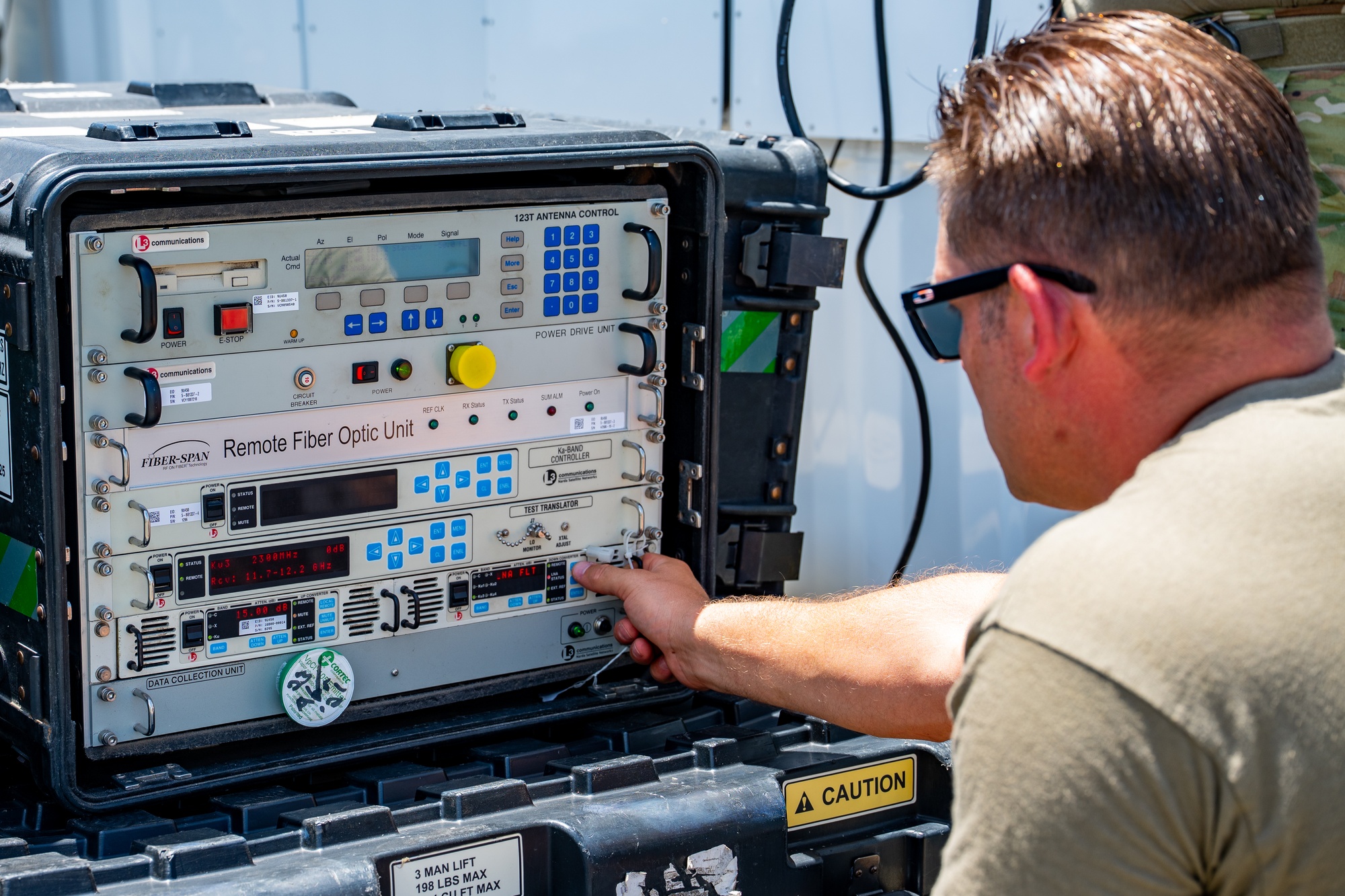
Photo details
Photographed July24,2025 during ResoluteSpace2025. This is an exercise photograph, not a photograph of an attack or of the KA-SAT system. DVIDS marks this specific work public domain. Original composition retained.Civilian dependence is often less visible than a satellite dish. GPS supplies precise time as well as location. GPS.gov describes its use in power plants and substations, where synchronized measurements help engineers trace an electrical disturbance back to a broken line. That does not mean losing GPS automatically blacks out the grid. It means protecting the service requires knowing which function depends on the signal, how long it can continue without it and which substitute is available.
For planners, this changes the unit of measurement. A satellite count describes hardware. A service test asks whether a warning arrives soon enough, a message gets through or a clock remains accurate enough to perform its job. Those are the outcomes for which taxpayers and customers are paying.
The factory has to keep delivering
The United States is pursuing a major answer to concentrated vulnerability: distribute missions across large constellations and refresh technology frequently. The Space Development Agency’s Proliferated Warfighter Space Architecture is intended to provide capabilities including missile warning and tracking from low Earth orbit.
But the Government Accountability Office’s January assessment found that SDA had overestimated the readiness of some critical technologies, creating unplanned contractor work and further delays. Combatant commands told auditors they lacked sufficient visibility into requirements and delivery schedules. Spacecraft production and useful military capability were proceeding on different clocks.
GAO described a constellation expected to cost nearly $35 billion through fiscal 2029, with satellites requiring replacement roughly every five years. It found no integrated schedule for the architecture and no reliable life-cycle cost estimate for its missile-warning and tracking capability. Those are findings from that assessment, not a new October estimate. The Defense Department agreed with five of GAO’s six recommendations and partly agreed with the sixth.
A short replacement cycle makes a constellation a continuing industrial commitment. Factories must repeat deliveries; suppliers must sustain them; software and ground equipment must keep pace. A successful launch cannot demonstrate all of that. If a ground system is late, or the user cannot employ the data, a new satellite may add little immediate operational value.
Commercial industry offers another source of capacity, but government must be able to use what it buys. In August, GAO reported that the Space Force’s Joint Commercial Operations Cell had spent $76.8 million through a data marketplace from January 2023 through September 2025. Purchases supported missions including monitoring activity in orbit and tactical surveillance and reconnaissance.
Some potential users nevertheless hesitated over licensing costs, perceived restrictions and uncertainty about long-term access. A monthly government working group could have addressed some concerns, auditors found, but the affected Space Force officials were not participating and information about the group was not widely available. The department agreed to improve awareness.
This administrative gap carries a larger lesson. An image available for purchase is not yet information an operator can reliably use. Contracts, sharing permissions, trained personnel and continuity of access are part of the capability. American commercial ingenuity delivers its full national benefit when those arrangements are ready before an emergency.
The wreckage remains

Photo details
NASA astronaut DonPettit made this long-exposure photograph January29,2025 from the InternationalSpaceStation over the Pacific. NASA published it February26,2025 and credits NASA/DonPettit without a third-party copyright notice. It is not an image of space debris or a counterspace weapon. NASA-supplied2048px rendition, composition retained.Industrial capacity alone cannot protect access to orbit. Destroyed satellites do not conveniently disappear. Fragments continue traveling around Earth, threatening other objects they encounter. At orbital speeds, even small pieces can do serious damage, and a collision can create still more debris.
DIA says more than 2,400 trackable fragments from China’s 2007 destruction of its own weather satellite remain in orbit. The exact count changes as objects reenter or are tracked, but the lasting consequence is clear: a weapons test conducted nearly two decades ago remains a burden on other operators.
The European Space Agency’s September 2026 environment report, using data through the end of 2025, finds improving disposal practices alongside growing traffic. It counted more than 300 launches and over 4,000 new payloads in 2025. Its warning is about an accumulating process: collisions create fragments that can cause further collisions. Debris can keep increasing even without new launches, ESA says, making active removal necessary alongside better prevention.
That is not a prediction that every orbit will suddenly become unusable. It is an economic and strategic constraint. American military power and commercial prosperity require an environment in which spacecraft can operate and replacements can arrive. Measures that protect that environment are part of readiness, even when they produce no dramatic launch-day photograph.
What PVweekly.com proposes
The following are editorial proposals drawn from this reporting, not recommendations attributed to DIA. They should be pursued in this order, with performance measured in usable services and recovery times.
First, test the service through to the user. The Space Force and civilian infrastructure agencies should require demonstrations in which an important link, control facility or provider becomes unavailable. Continue the exercise through the receiver and the person using its output. Record whether the warning arrives, the message gets through or the timing remains adequate. Publish aggregate results without revealing sensitive vulnerabilities. Exercises consume operating time, but they expose dependencies while there is still time to fix them.
Second, buy alternatives that operators have practiced using. Critical communications and data contracts should specify how service can move to another provider, which equipment is needed and which partners may receive the information. Infrastructure operators should document how long backup clocks or other timing sources support their applications. Common interfaces can ease switching, while common software can introduce shared weaknesses; both deserve realistic testing. Pay for redundancy that survives a demonstration.
Third, measure replenishment from the factory to restored service. Reserve production and launch capacity for selected critical missions, maintain compatible ground equipment and fund repeatable acceptance tests. The Space Force’s VICTUS HAZE demonstration illustrates one part of the task: a June launch from New Zealand followed a readiness sequence with activation in less than 48 hours and a requirement to be ready to launch on 24 hours’ notice. Those are meaningful results for prepared teams. They do not describe how quickly an unbuilt satellite can be manufactured and made operational. Congress should require the complete timeline, including components, integration and commissioning. Reserved capacity costs money; prioritize services whose loss would have the greatest consequences.
Fourth, connect procurement decisions to operational delivery. Follow through on GAO’s call for an integrated architecture schedule and credible life-cycle costs. Give actual users a role in deciding which capabilities must arrive first. Resolve commercial-data permissions, including allied access, before a crisis. These steps cannot remove engineering risk. They can reveal when a delayed component threatens the value of everything delivered around it.
Fifth, protect the orbital environment that replacements need. Build demanding disposal and debris-prevention requirements into government purchases. Support measurable debris-removal demonstrations and pursue specific international commitments against destructive testing and hazardous interference. Share sufficient information about unusual close approaches to reduce miscalculation. Verification will remain imperfect, and cooperation cannot replace defense. It can help preserve access while making dangerous behavior easier to identify.
The most persuasive demonstration of American space strength would end with a user receiving a needed service within a tested deadline after an interruption. Getting there requires spacecraft, but also factories, secure networks, workable contracts and practiced operators. The modem shipments after KA-SAT showed how much of that work can remain on Earth.
Sources
- DIA: 2026 report, all 130 pages and release announcement. Principal report passages: printed pages 7, 9, 20–21, 26, 29, 34, 41–42, 47, 52, 60, 67–72.
- Viasat’s KA-SAT incident account; British government’s allied attribution; GPS.gov on timing.
- Secure World Foundation’s 2026 counterspace assessment; Space Force’s account of Meink’s September speech.
- Russia’s May 2024 UN statement; Outer Space Treaty, Article IV.
- GAO’s January missile-warning assessment; GAO’s August commercial-data audit; Space Systems Command’s VICTUS HAZE account.
- ESA’s 2026 space environment findings.