

The Air Force’s April 2024 choice of Anduril and General Atomics paid for the next test of its drone-fighter ambitions: could the companies turn their designs into aircraft representative of something the service could manufacture?
On April 24, the service announced it was exercising options for detailed design, construction and testing under the Collaborative Combat Aircraft program. The selected firms would build the test vehicles. The decision did not award the eventual fleet-production contract or exclude other vendors from competing for it.
That distinction was central to the acquisition strategy. The Air Force said the broader supplier pool contained more than 20 companies and emphasized continued competition. It then expected a production decision for the first increment in fiscal 2026, with fully operational capability before the decade ended. Those dates described the planned path ahead of the 2024 work.
The test-aircraft phase was supposed to reduce uncertainty along that path. Calling a vehicle production-representative carries a more demanding purpose than merely demonstrating that an unusual aircraft can fly: the design must inform decisions about what to build repeatedly, test and support.
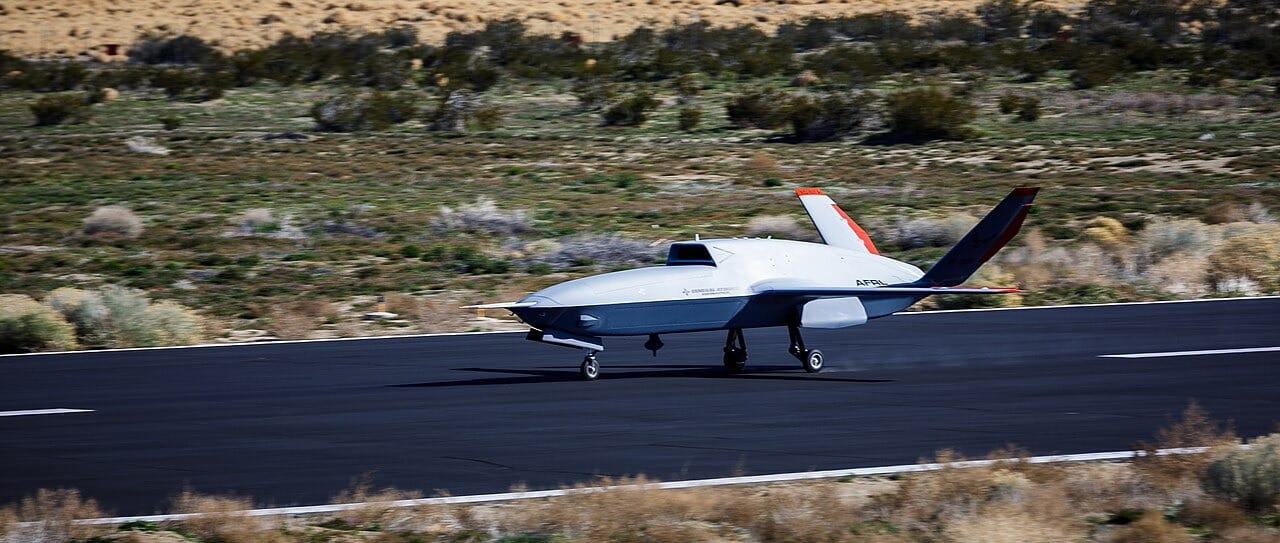
General Atomics’ account showed how much work preceded the option award. The company said an initial six-month phase had ended with a preliminary design review earlier in 2024. The new work covered critical design, building and flight testing. It also identified the XQ-67A Off-Board Sensing Station demonstrator as the basis for its CCA design.
That demonstrator had first flown on February 28 at the company’s Gray Butte facility near Palmdale, California, according to the Air Force Research Laboratory. It represented a separate research step toward aircraft sharing a common structural foundation.
The laboratory’s concept borrowed from manufacturing product families. Instead of starting every aircraft from a blank design, engineers would reuse a core set of structures and subsystems, then configure variants for different tasks. The intended benefit was faster development and lower cost. The February flight demonstrated an aircraft built using that approach; it did not establish the future CCA fleet’s unit price or annual production rate.
The laboratory also described why the aircraft itself was only one part of an autonomous collaborative platform. The full system included autonomy software, the interface with human operators, sensors and weapons, communications and the air vehicle. A sound airframe could reduce development risk while leaving important questions about team behavior and mission integration unanswered.
General Atomics said it would continue autonomy and mission-system tests using its MQ-20 Avenger and XQ-67A alongside the CCA contract. That parallel work gave the company ways to develop software and integration experience before the new production-representative aircraft completed their own flight program.
The Air Force’s ambition was a fleet of at least 1,000 CCAs. The April decision funded a much nearer task: generate credible aircraft and test evidence for deciding how that fleet could be built. Its significance lay in connecting research, detailed design and an eventual production choice without treating any one of those stages as the finished capability.
Sources
- Air Force exercises two Collaborative Combat Aircraft option awards — U.S. Air Force · 2024-04-24.
- GA-ASI Selected to Build CCA for AFLCMC — General Atomics Aeronautical Systems · 2024-04-24.
- AFRL’s XQ-67A makes 1st successful flight — Air Force Research Laboratory · 2024-02-29.