
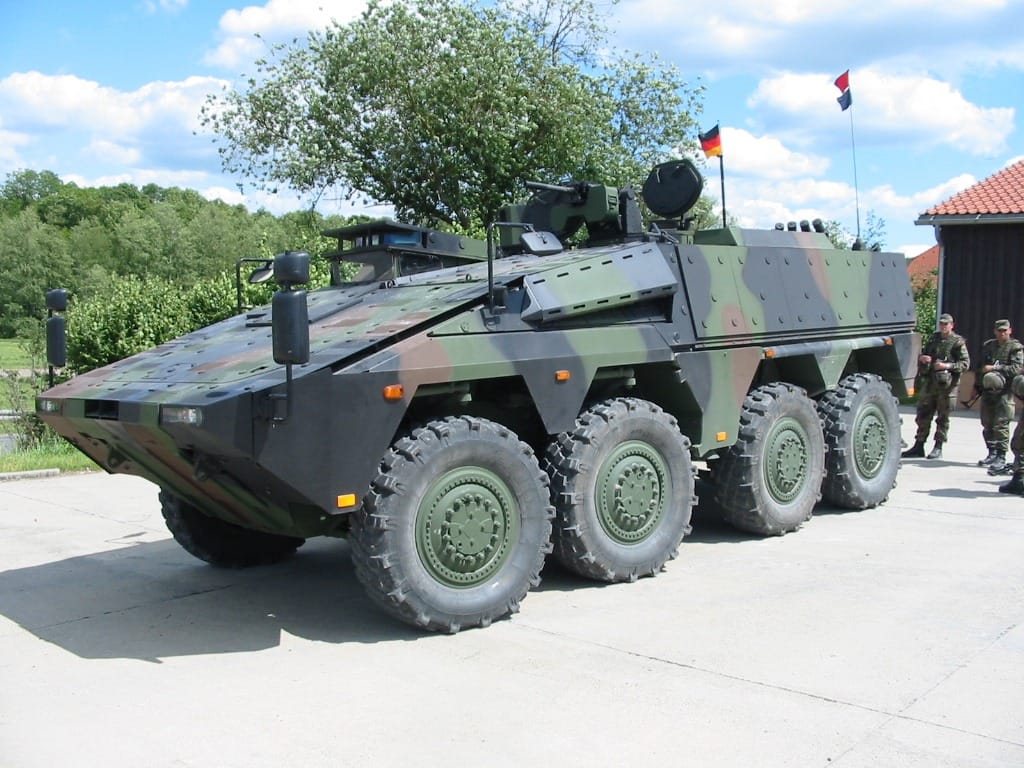

Britain’s first domestically built Boxer was one vehicle in a planned fleet of 623. Its appearance in January 2025 mattered because it demonstrated a production capability the country would need to repeat hundreds of times, alongside continued manufacturing in Germany.
The Ministry of Defence unveiled the vehicle on January 21 at the International Armoured Vehicles conference in Farnborough. Rheinmetall BAE Systems Land had manufactured it in Telford, working with KNDS UK in Stockport and British suppliers. The international procurement organization OCCAR reported delivery of the first British-produced vehicle to the UK customer.
The milestone was therefore more than an exhibition display. It marked the emergence of domestic output within a multinational armored-vehicle program. OCCAR connected it to two UK production lines, in Telford and Stockport, and to the work of bringing additional suppliers through qualification.
The Ministry of Defence said roughly 75 percent of Boxer components were sourced domestically. That statement described the supply chain’s composition; it did not mean every component of the first British-built vehicle originated in Britain. The same announcement made clear that initial production also remained underway in Germany as British manufacturing developed.
For the British Army, Boxer’s purpose was protected movement of soldiers and their mission equipment around the battlefield. The eight-wheeled platform was intended to equip mechanized infantry within armored brigade combat teams, making it part of the renewal of a major American NATO ally’s ground forces.
The Army’s equipment description identified troop-carrying, ambulance, command and specialist-carrier versions. That mix matters: a brigade needs to move wounded personnel, direct operations and support fighting units as well as carry infantry. Different configurations allow a common vehicle family to serve several of those tasks.
Britain was purchasing an existing vehicle design and integrating equipment it already used, including radios, electronic countermeasures and remote weapon systems. The Army also described provision in the design for later additions, including an active protection system. Leaving space, power and architectural capacity for a future system is a design choice; it is not evidence that the system has already been installed across the fleet.
The pace of the broader program became clearer in an April 28 parliamentary answer. Defence Procurement Minister Maria Eagle reported that 24 of the 623 series-production vehicles had been contractually delivered to the Ministry of Defence. All five standalone prototypes had also arrived, while more than 100 vehicles were in production across British and German factories.
Those were three different measures: prototypes for development, accepted production vehicles and unfinished work on factory floors. Eagle described further steps through industrial completion, testing, Ministry of Defence acceptance and delivery to Army users for training.
The January Boxer established that Britain could manufacture the vehicle. The subsequent production challenge was to turn that first result into a steady flow through acceptance and training, so that a factory milestone would translate into equipped formations.
Sources
- First British-made Boxer vehicles ready for Army — UK Ministry of Defence · 2025-01-21.
- IAV 2025 OCCAR Presents Latest BOXER Programme Status and First British-produced BOXER Vehicle Unveiled — OCCAR · 2025-01-21.
- Boxer — British Army.
- Boxer Vehicles: Question 45054 — UK Parliament / Ministry of Defence · 2025-04-28.