
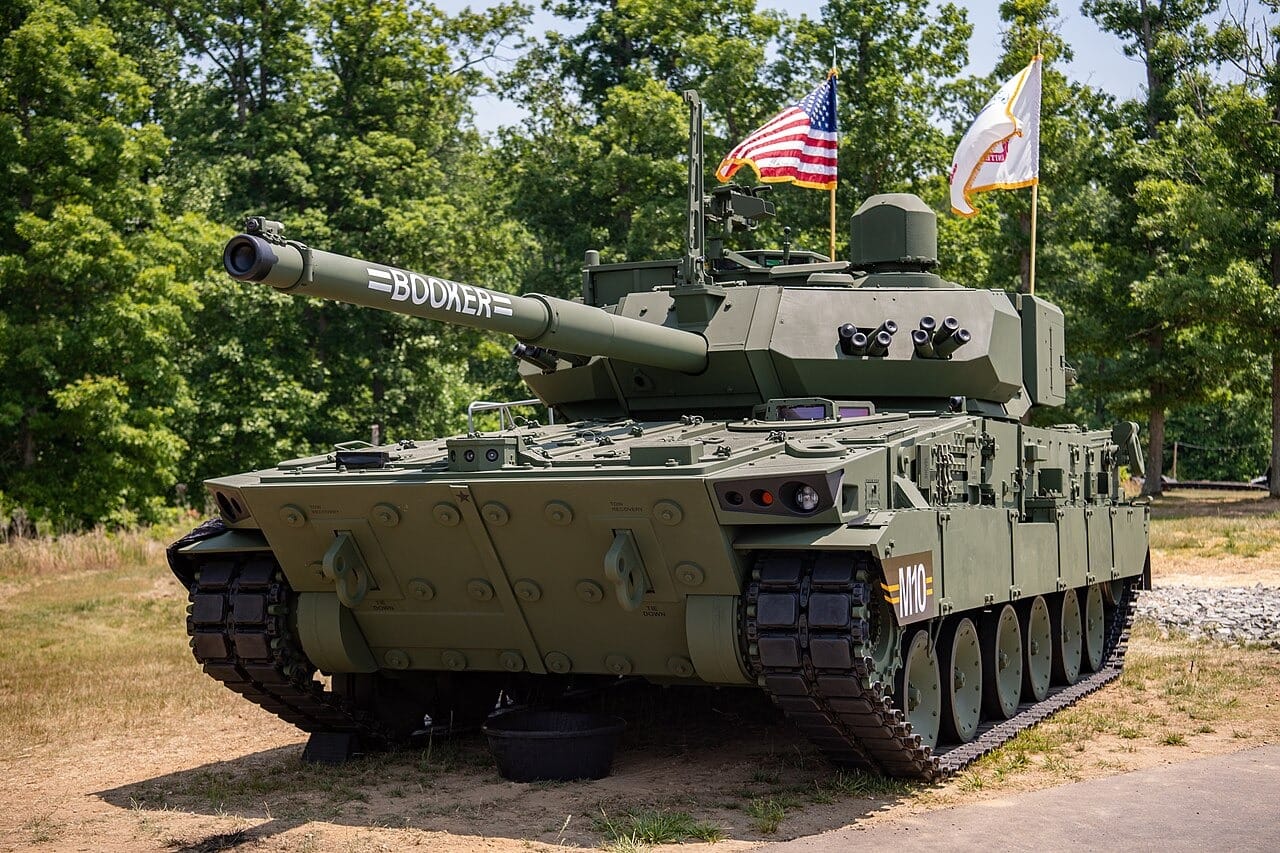

The Army’s decision to stop buying the M10 Booker left two things moving in opposite directions: the planned vehicle fleet was shrinking, while the work of closing its contracts was just beginning.
On June 11, 2025, the service announced it had issued a termination for convenience covering the combat vehicle’s low-rate initial production effort and would not proceed to full-rate production. The decision gave the Army Transformation Initiative a concrete procurement consequence. A program intended to put protected direct fire alongside infantry would no longer grow into the fleet previously envisioned.
General Dynamics Land Systems had received the initial production contract in June 2022, when the vehicle was still known as Mobile Protected Firepower. That agreement covered production and fielding of up to 96 vehicles. The ceiling described the contract’s potential scope; the June termination announcement did not say that 96 vehicles had been delivered.
The original battlefield problem was specific. In its 2024 acquisition portfolio, the Army described a vehicle that could help infantry brigades defeat bunkers and light armored vehicles while preserving their ability to advance. Its combination of protection, mobility and direct fire was meant to give those formations support they could take with them.
By May 2025, Army leaders were describing a different organizing priority. In a May 1 letter, Secretary Dan Driscoll and Chief of Staff Gen. Randy George outlined plans to make infantry brigade combat teams more mobile, introduce new unmanned systems and improve long-range fires and counter-drone capabilities. Their broader argument was that formations and procurement had to adapt together. The Booker cutoff followed that policy shift.
The financial consequences required more steps. The June announcement said the Army would request permission to redirect remaining fiscal 2025 funds and expected additional savings to materialize over the following 18 to 24 months. Those were proposed reallocations and forecasts, rather than money already recovered for another weapon.
The Army’s June budget books showed the administrative transition in progress. The procurement justification described a partial termination for convenience and said there was no planned fiscal 2025 Booker purchase. It also acknowledged that an earlier quantity still appearing in the budget would need updating. Acquisition and procurement objectives likewise awaited subsequent decisions.
A separate research-and-development justification said fiscal 2026 funding would support contract termination costs, with remaining resources to be moved toward transformation priorities. That is why a canceled weapon could still appear in a future budget: ending development and production commitments can itself require spending.
The June announcement left the disposition of remaining assets to the termination process. It did not identify a final settlement, assign every vehicle a destination or establish that other purchases had already replaced the Booker’s intended infantry-support role. The measurable next results were therefore unusually practical: close out the contract, determine what happens to the equipment, and show where the released funding actually went.
Sources
- Army to cease procurement of M10 Booker Combat Vehicles — U.S. Army · 2025-06-11.
- Letter to the Force: Army Transformation Initiative — U.S. Army · 2025-05-01.
- U.S. Army Acquisition Program Portfolio 2024 — U.S. Army.
- FY 2026 Procurement of Weapons and Tracked Combat Vehicles budget justification — U.S. Army · 2025-06.
- FY 2026 RDT&E budget justification, Volume 3, Budget Activity 5A — U.S. Army · 2025-06.