
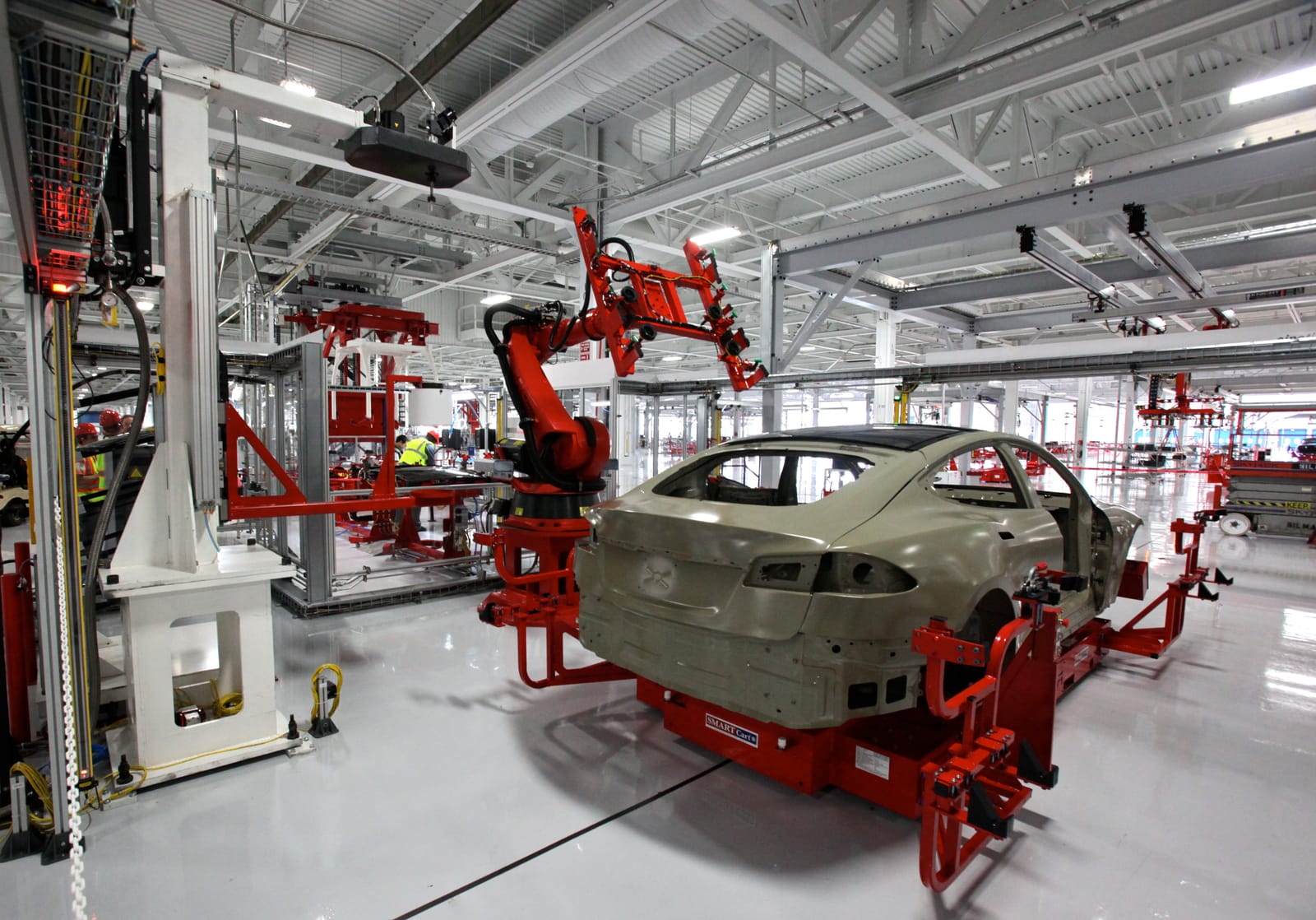
The White House says the United States cannot make enough of the robots and industrial machines it needs. It also says the country is leaving some of its existing capacity to make them unused.
Those two findings sit together in President Donald Trump’s October 28 proclamation on machinery imports. They describe a problem that changing prices at the border alone may struggle to solve. The administration wants manufacturers to build more equipment in America, but those manufacturers need customers—and their customers need affordable, dependable ways to expand production.
The proclamation imposes no new tariff. It directs the Commerce Department and the U.S. trade representative to negotiate with trading partners after accepting Commerce’s finding that imports of robotics, industrial machinery and their components threaten to impair national security. Tariffs, quotas, fees and incentives for domestic production remain possible later steps.
For a machine builder, the negotiations could eventually bring protection from foreign competitors or new investment incentives. For an American factory buying equipment, they create uncertainty over future costs and supply. Both businesses belong to the industrial base Washington wants to strengthen. Success will depend on whether the eventual policy expands their capabilities together.
What the order actually changes
Commerce and the trade representative must provide Trump with a progress update within 180 days, a period ending April 26, 2027. Commerce must also keep monitoring imports and advise the president when it sees a need for further action. The proclamation does not require a public progress report or set an automatic tariff increase for the end of that period.
There is no new duty rate, customs-code annex, country exemption list or schedule for combining new duties with existing ones. Nor does the order create an investment program now; it identifies one as a possible future remedy. An equipment buyer therefore has no new tariff from this proclamation to put into a purchase estimate, and no promised subsidy to deduct from it.
The investigation, begun September 2, 2025, covered much more than robotic arms. Its public notice included computer-controlled machining centers, turning and milling machines, grinding equipment, industrial presses, automatic tool changers and the fixtures that hold parts during manufacturing. It also included specialized equipment for treating and cutting metal. Unmanned aircraft systems were excluded from that investigation because they were being examined separately.
That breadth matters. A machine tool removes or shapes material; a robot may load the material, move a part or perform a weld. A factory can need both. Restrictions affecting their components could reach businesses that make machines as well as the businesses that buy them. The investigation’s broad description, however, is not a tariff schedule determining the treatment of a particular shipment.
The proclamation presents the national-security case in direct terms: equipment used to produce aircraft, ships, weapons and munitions also determines whether the defense industry can increase output during a conflict. It says foreign reliance threatens the industrial base’s competitiveness and that equipment from certain foreign entities can introduce cybersecurity and safety risks. These are Commerce’s findings as summarized by the president, not independently demonstrated consequences of every imported machine.
An equipment producer and an equipment buyer
The administration’s concern has a recognizable industrial logic. A country may possess designs, customers and assembly buildings yet depend on suppliers abroad for the equipment that turns a design into a physical product. If it cannot replace or repair that equipment reliably, expanding finished-product capacity can leave an important dependency intact.
But producing robots and using robots are different measures of strength. The International Federation of Robotics reported in September that the United States installed almost 38,500 industrial robots in 2025, up 12 percent and enough to move ahead of Japan into second place among national markets. China installed about 354,000, accounting for 59 percent of the global total. These are installation figures, not counts of machines manufactured domestically.
The comparison captures the scale of demand available to equipment suppliers. It does not establish how productive a particular American factory is, and the countries’ manufacturing sectors differ in size and composition. It also covers industrial robots rather than the proclamation’s much larger collection of machinery and components. America’s machinery question cannot be reduced to a single robot ranking.
The Association for Advancing Automation, or A3, made the buyer’s case in an October 2025 submission to Commerce. The trade association urged against tariffs on countries supplying robots and key components needed by U.S. industry. It identified shortages of domestically produced controllers, motors, drives, castings and gearboxes, and argued that building those supply chains would require investment and workforce preparation over years.
A3 represents businesses with a commercial interest in equipment sales and access to foreign suppliers. Its submission is an industry argument, not a neutral forecast. Still, it identifies a practical exposure: an American company integrating a production line may buy imported components before it can deliver an American-built system. A policy intended to help equipment producers can raise some producers’ costs along the way.
There is historical evidence for that tension. The U.S. International Trade Commission’s 2023 study of earlier tariffs estimated that Section 232 measures increased domestic steel production by 1.9 percent and aluminum production by 3.6 percent on average during 2018–2021. Producers received a measurable benefit from protection.
The same study estimated that industries using steel and aluminum produced an average of $3.4 billion less each year than they would have without those tariffs. Industrial machinery manufacturing was among the most negatively affected industries. These were modeled short-term effects of earlier metals tariffs, not a forecast for robotics. The commission did not assess national-security benefits, long-term investment effects or the full economy-wide balance.
The lesson is narrower than an argument for or against every tariff: gains to an equipment supplier and costs to its customers need to be examined together. If future negotiations produce import restrictions, the important variables will include which products are affected, where substitutes exist, how quickly suppliers can expand and whether buyers can keep projects moving during the transition.
A machine becomes useful after it arrives
A machinery project documented by the National Institute of Standards and Technology shows what that transition involves. Titan International Sales, which supplied both domestic and imported electrical discharge machining equipment, wanted to improve how it customized and commissioned advanced machines for customers. Its American-made Titan Force line was part of that effort.
Electrical discharge machining uses electrical sparks to remove material with precision. For Titan’s customers, acquiring the equipment also meant choosing a configuration, installing it and getting it working in a particular shop. In NIST’s account, published in 2022, NextCorps Growth Services, part of New York’s Manufacturing Extension Partnership, worked with automation specialist Digitronik Labs to improve that process.
The work involved applications, database scripts, motion programs and drivers—the software needed to make a complicated machine perform its intended job. Further development added capabilities including a system for robotic material handling. NIST reported that a new Titan Force drill machine was installed at Fleet Readiness Center East, the Navy aviation repair and maintenance facility in Havelock, North Carolina.
The sequence matters. Domestic equipment reached a defense customer through engineering and deployment work as well as manufacturing. This earlier program case study offers no measure of Titan’s present capacity. It does show why expanding the machinery industry requires more than adding machines to a warehouse or announcing factory floor space.
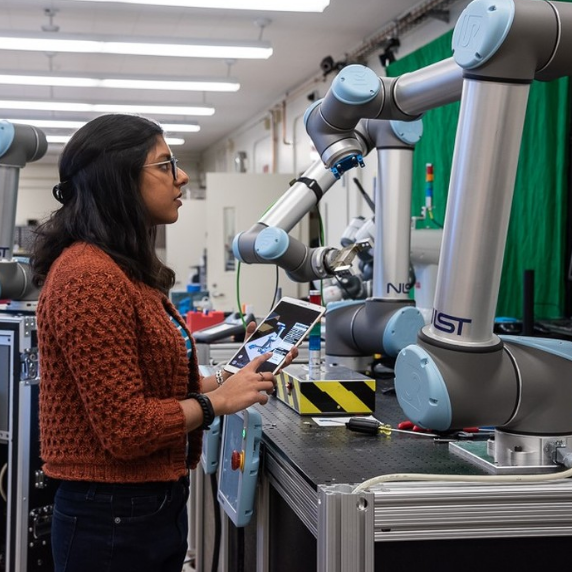
Photo details
NIST’s Laboratories page credits this photograph to NIST and identifies a person with a tablet beside a robot in a NIST lab. Capture date is not stated. This is a research setting, not a photograph of Titan Force or the Navy repair facility. Original composition retained.NIST’s guidance for smaller manufacturers makes the same distinction at the buying end. Its 2021 study of collaborative-robot integration calls attention to mounting equipment, fixtures, tools, vision systems, training and the information exchanged between a robot and other machines. It also urges manufacturers to understand what maintenance and support an integrator actually provides. The robot’s purchase price is only part of the project.
For a small shop, these requirements compete for the same time and money as production. A promising automation project can still require changes to the way parts are presented, people are trained and problems are diagnosed. NIST warns that poor estimates of integration and commissioning can cause disruption and downtime. Making the hardware easier to buy does not, by itself, make the whole installation easier to complete.
Workers are central to that installation. The Bureau of Labor Statistics projects employment for industrial machinery mechanics, machinery maintenance workers and millwrights, taken together, to grow 14 percent between 2025 and 2035. It attributes part of the demand to automated equipment that needs to be kept in working order. That is an occupational forecast, not an estimate of jobs created by Trump’s proclamation.
The outlook is uneven even within that group: BLS projects growth for industrial machinery mechanics but a decline for machinery maintenance workers as tasks shift and maintenance becomes more efficient. Training cannot be treated as a promise that every displaced worker will find an equivalent job. It is a concrete requirement for people expected to install, operate, troubleshoot or repair the new equipment.
Security continues inside the factory
The proclamation raises a second problem that an import price cannot fully describe. Robots and industrial machinery can process or store sensitive information and connect to other manufacturing systems. Commerce’s concern includes what a foreign entity might be able to access through the equipment, as well as whether the equipment will remain available.
NIST’s 2023 guidance on operational technology—the systems that monitor or control physical processes—explains the exposure. Connections that allow remote maintenance can also reduce a plant’s isolation from outside networks. Its recommendations include separating networks, using multiple factors to authenticate remote access and controlling maintenance connections. It calls for remote-maintenance tools that identify personnel, log their activities and end connections once the work is finished.
That turns supply security into a set of practical purchasing questions: who can connect to the machine, under what conditions, and what happens when maintenance is required? Domestic production can reduce some supply risks. It cannot substitute for understanding software, access permissions and support arrangements. A tariff payment at the border is not a cybersecurity test.
What the negotiations need to accomplish
The proclamation leaves negotiators room to address these different problems. It also leaves the public without the detailed product-by-product evidence needed to judge the proposed response. The White House’s action and accompanying fact sheet summarize Commerce’s report but do not link to it, identify its exact transmission date or explain which domestic production lines are underused. The finding of both insufficient capacity and underutilization deserves a clearer account.
A useful first step would be to distinguish equipment that American firms can already supply in greater volumes from equipment that requires new technical capability or a new component supplier. For the former, dependable demand may matter most. For the latter, orders alone may be insufficient. Publishing enough of that assessment to let manufacturers and customers test it would make subsequent restrictions or incentives easier to evaluate.
Any negotiated transition should also account for factories already relying on foreign equipment. Agreements with capable trading partners could pair continued access to necessary machines and parts with measurable commitments to U.S. production, service and training. The relevant milestones would be operating lines, available replacement components and demonstrated delivery capacity. An announced investment would establish intent; it would not yet establish a substitute supplier.
If the administration creates the investment program the proclamation contemplates, the NIST records suggest a practical design: support deployment and worker preparation alongside equipment production. Smaller manufacturers need access to engineering help, realistic project budgets and maintenance arrangements. Assistance could be tied to completed installations and measured production improvements, using the before-and-after process comparisons NIST recommends, rather than counting purchases alone.
Security requirements should be equally specific. Buyers can demand clear records of remote access, service responsibilities and component dependencies while agencies distinguish supply-continuity risks from risks posed by control of data or software. Those problems can overlap, but they do not always require the same remedy. Targeted requirements would give suppliers something concrete to satisfy and customers something concrete to verify.
The April 26 reporting deadline gives the administration an early checkpoint for those commitments. The larger test will come on factory floors: can American equipment makers deliver more, and can the manufacturers relying on their machines expand reliably? A policy that improves both would turn the proclamation’s promise of industrial strength into something builders, workers and customers can use.
Sources
- White House, presidential proclamation on robotics, industrial machinery and components and accompanying fact sheet, October 28, 2026. The proclamation was read in full; it contains no product-code annex or new tariff schedule.
- Commerce Department, Bureau of Industry and Security, original investigation notice, 90 FR 46382–46383, September 26, 2025.
- International Federation of Robotics, World Robotics 2026 public findings, September 24, 2026. Installation figures concern 2025.
- Association for Advancing Automation, public submission to the Section 232 investigation, October 17, 2025, particularly PDF pages 1 and 3. Industry positions are attributed to the association.
- U.S. International Trade Commission, Economic Impact of Section 232 and 301 Tariffs on U.S. Industries, March 2023, corrected May 2023; executive summary, pages 18 and 21–22. The study’s estimates concern 2018–2021 and do not assess the full economic or national-security balance.
- National Institute of Standards and Technology, Titan International Sales machinery deployment case study, created February 17, 2022, updated June 6, 2023; collaborative-robot integration guidance, AMS 100-41, May 2021, particularly printed pages 7–9.
- Bureau of Labor Statistics, occupational outlook for industrial machinery mechanics, machinery maintenance workers and millwrights, updated August 27, 2026. Employment projections cover 2025–2035.
- National Institute of Standards and Technology, Guide to Operational Technology Security, SP 800-82 Rev. 3, September 2023, particularly printed pages 4, 28, 41 and 86.